Showing posts with label Bible. Show all posts

Monday, August 2, 2021

Why I am discontented with Robert Kuhn's 'Closer to Truth'

The Mission of getting Closer to Truth

I can't say that I have listened to all Robert Kuhn's series in his format called Closer To Truth. There is a vast library now of 3500 videos of the world's greatest thinkers. Over the years I dipped into quite a few. Overall Robert Kuhn has done a magnificent job in covering such a range of views and expertise that is rarely found with such sympathetic yet probing integrity. His interviews cover physicists, biologists, scientists, philosophers, theologians, historians and many scientific disciplines of all hues.

I found them all interesting in that they were interviews with specialists and experts but I came away dissatisfied with almost all of them.

Why? 

True and whole Science

I found that they lacked a coherent scientific structure. Academic disciplines are becoming more and more separated into silos and few experts can have the vision of an overview from the heavens to the deep analysis of the infinitesimal detail. Silo-hopping results in lack of overall cohesion. Then there were failings of internal logic, which is natural. As humans we are all reluctant to yield our own prejudice for pure fact and logic. This is especially the case when it comes to theological foundations of knowledge. Materialistic liberalism infuses much modern thought, even (or especially!) among theologians. Iron needs to sharpen iron, but the right sort of iron is needed to make a sharp blade to bring overall satisfaction. Some borrow extradisciplinary iron that is already rusty.

Theology creates the big divide in academia, where the predominant philosophy disdains it. Knowledge of God requires logically obedience to God as our Creator. Or at least reverence and awe. Skeptics disparage moral laws. Or to put it another way, those who refuse the Ten Commandments call themselves atheists or excuse themselves with a religious label. What is their conscientious objection? 

True science requires a pure conscience. A persistent, pure conscience can also break empires. The conscience of Judeo-Christian believers in DDR, Hungary, Poland and Russia brought the downfall of the atheistic USSR. It showed Marxism was unscientific. The Politburo was biased. It banned free discussion of the spiritual, or non-materialism. Education in Museums of Atheism did not work.

Today, however, the West is still suffering from USSR's ideological attacks and materialism that emptied churches and more. Soviet propaganda undermining society structures was long-lasting. Now the more subtle Chinese atheism and autocracy produces thousands of choking weeds. But even media and internet censorship in USA will not stop the quest for truth. There may be more professing Christians in China than in Europe.             

Origin of modern Science

The scientific method derives from classical reform theology. In our modern era, the Hon Robert Boyle in the 17th century and later the Royal Society laid down personal rules that a searcher for truth must make sure that his conscience is absolutely clear of prejudice, and preconceptions. Experiments must be totally impartial. Facts and logic should provide the answers. The early scientists learned logic from the Bible -- for example debunking apparent contradictions by testing multiple hypotheses. They also compared the standard Roman Catholic belief and myths with historic documents now published and translated into the common languages for the first time. The vast collection of papal claims made over a millennium were exposed as frauds. 

Today our knowledge is increased in many areas. (In some other areas it has declined, such as the motor motive of science that there is one truth and fraud should be exposed and rejected.) The ideology of the popes is replaced by a Darwinistic / neo-Marxist premise (both failed theories). That results in false conclusions that everything evolved or economics dictates all human history and knowledge.

It is not progress to turn all phenomena into mindless, purposeless materialism. Such nonsense permeates the whole framework of present day thought. It represents the greatest danger to civilization -- materialism, only matter is important, not the spiritual world. Did electrons evolve to create Dark Energy, did amoebas grow to become elephants? Was it a triumph of workers over capitalists? Class warfare failed, so atheistic Marxists turn to race wars as the new Dialectical materialism.

Use your brain!

All civilizations knew that human mind is different from rocks and chemicals and far superior in its potential to the animal brain. The whale does not do better at mathematics or astronomy because its brain is seven or eight times bigger than man's 1300 gms. Or an elephant brain with 256 billion neurons, three times more than a human.

On the other hand some birds can circumnavigate the whole planet and find their way home. The aptly named godwit, shaped like a high tech fighter aircraft, travels from Alaska to New Zealand in one go, and later flies back across oceans. No stops for food.

Some humans get lost in their own city. Could you manage two non-stop trips totalling 29,000 kms?

The godwit reduces the size of its internal organs to make space for fuel. Its brain size? The whole bird weighs about 300 gms -- and its brain must be just a couple of grams. Butterflies also travel across oceans and back.   


Big Picture

The search for truth must take all new facts and conclusions into account.

What new knowledge needs to be integrated?

The great scientists of its modern foundation period knew man was a spiritual being. They applied this knowledge. Newton and William Whiston, his successor as Lucasian professor of mathematics at Cambridge, John Wilkins, cryptologist, philosopher, Anglican bishop and first Secretary of the Royal Society, John Ray the pioneering biologist, and many others were fervent Christians. Science boomed because they were scientists in mind and spirit. Ray like Paley described how each creature was finely constructed for its own good purpose. The Bible animated all their researches. The same can be said for the next generations, such as Faraday and Maxwell who electrified our present society. Their electromagnetic wave theory is based on 'spiritual fields'. The designs of God indicate his purpose and plan but also act as a spearhead to new discoveries.

Your God is too small

No-God atheists and small-minded ministers need to stretch their minds to the reality of Creation and obviously the Creator. 

We know now that the Universe is far more magnificent and vast than any could have imagined. It stretches 14 or 15 billion light years to the visible rim. Who knows what lies beyond it?  The maximum speed of 74 km/second for a rocket was achieved by the Juno probe to Jupiter using the slingshot of gravitational assist. It would take such a probe 15 billion x 300,000 x 31.56 million seconds divided by 74 -- 6 trillion years -- to reach the rim of the universe and peak into what is beyond our visible sighting of stars. I can't wait that long.

The voyage is likely to be lonely. Even though the universe is dotted with stars and many may have planets, the Earth is the only known planet in our solar system and beyond where we know there is life such as bacteria. But we see good and negative spiritual forces in battle all day long. 

As we look deeper we find that the Earth has not only an extraordinary abundance of life but it is in forms that earlier man had could not imagine. Life exists in the deepest oceans and in the upper atmosphere. The simplest of cells, seen through microscopes, is as well organized as a massive city. But a cell has powers that go far beyond it. It can search for chemical foodstock. It can reproduce. It can make other cities. 

Each of the creatures on earth can tell us a lesson about how to live, care for young or not, or avoid our predatory enemies. They are education. We have a book of wisdom written in Nature. Modern technologies look to Nature's original design to find new designs and inspirations. 

Diseases caused by man's foolishness find their therapeutic solutions in Nature. The Nobel-prize-winning therapeutic Ivermectin, a powerful world-changing corrective and preventative to viruses (including in practice corona viruses), was found in the soil of a golf course in Japan by Satoshi Omura. It is one of the most tested, effective and cheapest of drugs. Then 'science' changed. Today the 'science' of its use may be distorted by profits of Big Pharma or a globalist agenda of those like WHO. 

A detailed View

Let's go smaller. Small, small fingers are required.

Last century's scientists started off by believing that the fundamental building blocks of our world, whether atoms or then atomic particles, would be simple systems. (atom= Greek indivisible) We could then work out the Lego construction of the universe.

The truth turned out to be far more complex, as is all nature. A whole zoo of particles and anti-particles, quarks, neutrinos, photons and strange and beautiful beasts act both as waves and particles. But they all work well and the average citizen does not have to look 'under the hood' to see how the material world works. Complexity and functionality is everywhere in harmony.

The universe is founded in wisdom down to the smallest detail we can figure out.

A pair of the smallest particles retain an intimate interconnection. When a human observes and measures one, the other, perhaps now at the far reaches of a galaxy, 'knows' and reacts faster than light travels. Man's decision-making affects the physical characteristics of the universe in ways we are only beginning to understand. Man operates on a spiritual plane. The human mind acts beyond the material physics.

From the least particle to the entire spread of the universe each brings a lesson to Mankind. The Great Creator God will not fit into man's box of experiences. From the stuff a billionth of a centimeter to that billions of light years, all give a lesson: if we wish we can grow in knowledge, wisdom and maturity. But silo academics must abandon 'Greek' thinking about atoms, universal measures of time and space to come to truth.

Truth, then what?

The crux of my remarks here would be to pose the question: where does one start?

Information, it has now been shown to the satisfaction of astrophysicists, can survive a Black Hole collision. Information existed before the beginning of the Universe 14 or so billion years ago. An impartial look at the existence of humankind and human observation of nature shows that it involves not only information but knowledge (from whence we deduce our sciences) and wisdom -- which is necessary for human maturity, the building of virtuous character.

Therefore all scientific analysis must start with the Wisdom Giver. Even the skeptics think they are wise. Usually groups of humans become unwise.

The early scientists were Jews or Christians but they shunned organised religion. Newton's researches led him to reject the pagan trinity. Whiston was expelled from Cambridge because of 'heresy'! Others adhered to obscure congregations of believers or were known as non-conformists and unitarians like many of America's founding fathers. They did not conform to crowd psychology. They rejected the church that absorbed paganism. They searched for truth and paid the price for non-conformity to errors. That showed that their pure conscience was fundamental to science and faith in God. Which scientist today is persecuted? Which scientist is not influenced by peer pressure or by grants from industry or government? Which real scientists are able to teach or debate in group-think universities?

After analyzing the proofs of God and how the atheistic skeptic refused them, Whiston concluded that biblical prophecy was paramount. He foretold in the 1700s, based on the Bible, that Jews would rebuild their homeland in Israel. A Temple would be built. The first happened in 1948, despite centuries of skeptics saying it was impossible. The second is yet to come. 

Diamond quality

Why did I feel unsatisfied with Closer to Truth? Getting close to truth is a start. Truth merely excludes the false. Wisdom is better than knowledge; knowledge is better than information, information is better than data. A diamond is more valuable than raw carbon. 

I was taught that Wisdom is the principle thing. Above all seek wisdom. Awe of the Eternal is the beginning of wisdom. 


Saturday, October 26, 2019

Why does Genesis say Abraham's army went to Dan before Dan was even born?

'When Abrahman heard that his brother was taken captive {by the army of a coalition of nations including Chedorlaomer, king of Elam, Tidal king of nations, Amraphel king of Shinar, and Arioch king of Ellasar) he armed his trained servants, born in his own house, three hundred and eighteen, and pursued them unto Dan.' Genesis 14:14.

The city of Dan was called Laish in the time of Abraham, long before the man Dan and his tribe existed. Dan was the son of Jacob, the son of Isaac, the son of Abraham.
The tribe of Dan conquered the city of Laish and called it Dan. The same question goes for the city of Ramasses (Gen 47:11) and in Ex 1:11. It is a later name for Avaris in the land of Goshen.  Pi-Ramesses was a later city built by Ramasses II on the site. What is the explanation? 
It is the same as saying that the Romans in Britain had a legion in York. York did not exist then. It was known as Eboracum. 
All the question is asking is who changed the names and updated the geography to modern recognisable names? The updates do not imply, and far less prove, that Moses did not write the Pentateuch or that the Romans did not invade Britain and have a fortress there because "York" did not exist at the time.
Who edited Moses and why? And under whose authority? Can anyone alter the texts? The answer to the last question is NO. There is a line of authority where responsibility for preserving the texts is passed on from generation to generation. New books are added to the canon under the supervision and imprimatur of the canon authority usually under the headship of a designated person.
It is often correctly pointed out that the last lines of Deut were probably added by Joshua who wrote the next book and was given authority as leader by Moses. How do we know?
Firstly the Pentateuch says so. The Hebrew Bible mentions later editors and canonisers.
There is also a document written by Hippolytus the Syriac Targumist who lists all the Canon Supervisors from Moses to Christ. The law, it says, was delivered by Moses son of Amram to Joshua son of Nun.
Fifty six Canon Supervisors are listed up to Joseph the Teacher. It includes Simeon the high priest 'who carried the Messiah in his arms' (Luke 2:25, known elsewhere as Simon Boethus). Simeon delivered it to Jehuda and Jehuda delivered it to Zechariah, the father of John the Baptist. Zechariah delivered it to 'Joseph the Teacher of his tribe'.
Technically the term Teacher refers to the Cohen haRosh (chief priest) who supervised the high priest (cohen haGadol) in his work and catechised the high priests. The NT uses the terms Tekton which is badly translated in Vulgate and Protestant version such as KJV as 'carpenter'! That is through the millennium-long influence of the RCC. (Geobbels and Soviet disinformation department of the KGB would have loved that amount of time to manage information!)
Tekton means technical expert. The NT also uses the term Master of the Holy House (Temple) oikodespotis. Jesus is called a Temple Teacher and so this Joseph the Teacher is most likely his father, Joseph. (Joseph of Heli or Elem in the Talmud, the Tosefta and Josephus).

As well as adding books to bring it up to the requisite 22 books corresponding to the letters of the Hebrew alphabet, the Canon Supervisors could with their editorial council bring geographical terms up to date. For more on this see Ernest L Martin's Restoring the Original Bible.
For the answer to the question:
Who finalized the Hebrew Scriptures and then the Greek ones see my article at


and Rome's fraud about the Bible canon at

Saturday, December 2, 2017

New Testament Q theory gets a failing 'D' grade


In a case before a judge in Court, a number of witnesses come forward and give their accounts. The accounts are all different in the sense that, though they keep the same chronology and essential facts, they are presented in different terms.
At base there is no contradiction.
Would the judge be correct to say they must all be wrong and made-up because they are coherent and concur? Obviously not. Logical coherence is an indicator of truth. If the witnesses are all known as honest people, he would come to the opposite conclusion.
They were all witnessing to real events.
Now turn to the Bible. That sort of logic disappears like vapor on a hot day when it comes to atheists trying to deal with the Gospels. They are confronted with miracles and the resurrection, in fact several resurrections. Atheists just 'know' that it can't be true. So they say the gospel writings must be myths and falsehoods kept alive at first by oral tradition. They say, there were no miracles, no resurrections. There was a band of dispirited disciples who were disappointed that Jesus did not vanquish the Roman armies. They say that only later the disciples got together to write down some favorable things about Christ and his sayings.
They start by denying some or all of the testimonies of the witnesses, then try to make up a story without the facts they don't like from the witnesses. How do you explain the world-changing power of Christianity? The facts they don't like turn out to be the crux of the case! Resurrections!
Then as a hypothesis to describe what happened, they have to explain why they mutilated the testimonies. How would the reduced facts lead any judge to come to the reality of what we see today about Christianity?

False premise.
The NT gospels, they say, were not written until perhaps a century later by surviving disciples or their followers. How then were the gospels so consistent and mutually supportive?
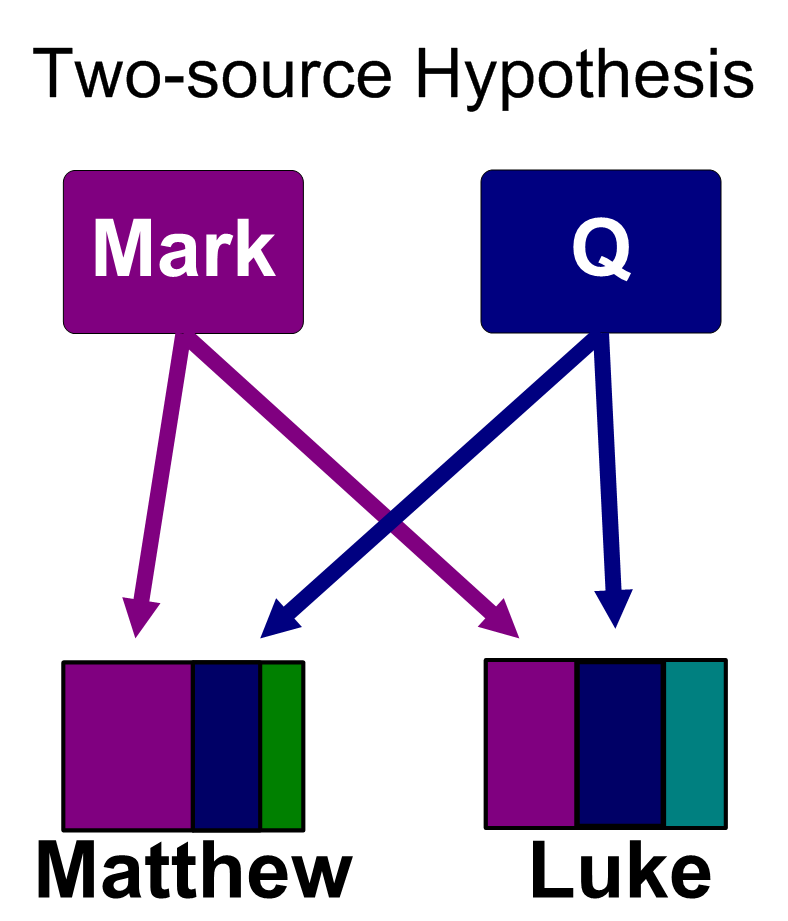
One attempt by these theoreticians was to try to say all the witnesses collaborated after a few decades by establishing a short, common written source. There were no miracles so this core was Christ's teachings. It was known as Q, for Quelle, source in German. Q was used to distinguish those passages in Matthew, Mark and Luke that look similar, one way or another. It is like saying: "I found a jigsaw piece that has the same shape as the gap to be filled -- more or less."
In the two source or multiple source theory, Q was added to the shortest gospel, Mark -- which they say was the early source --to edit and make versions called Matthew and Luke which are longer.

Q is a vapor!
Using Q as a basic story they supposedly invented other parts of the gospel narratives much later. Trouble is: no one has actually found this writing among the many thousands of manuscripts that have been preserved! We have more manuscripts of the New Testament than any other contemporaneous books in Greek or Latin -- thousands. Yet not one of Q!
 We have many early translations into Syriac, Coptic Greek, Gothic, Latin etc. Not one of Q!
Heretics made up lots of faked gospels. They survive in their hundreds. There is no manuscript of Q among them. Nor do the heretics use anything like Q! They all look like sectarian fakes!
Conclusion number one: Q did not exist.

Vapor dispersion
That does not stop Q theory being highly popular in seminaries today.
Most churches teach it. Why? 
While any sensible person would examine whether this idea is sound before teaching it, modern professors with no scientific training in logic don't. It has the superficiality of truth. It is a veneer only. Certain forms look alike. The problem is they don't make any sense.
Superficial form made it popular enough to be taken on board uncritically by church "teachers" who like to shock unprepared students. They in turn, when they become teachers, pass it on. Most church seminaries teach this false theory about the origin of the first three Gospels of the New Testament as fact. But the Q Theory or Q hypothesis is a falsifiable, as all theories and hypotheses are.

Delusion reigns.
This theory, created in 19th century Germany by skeptics and atheists wanting to destroy the primacy of the Bible, is now accepted widely by academics and theologians. By having a 'school' they can all write learned articles about the inconsequential details of a word, while ignoring the falsity of the whole.
It has become more and more popular as the level of general education has fallen. It can be refuted by a better understanding of first century history and a better application of logic.
Flawed logic of the Q theory should make it a target for debunking. But professors teach it rather than debunk it! Students seem unwilling to call out the errant professors. Theory masquerades as fact. Its basic prejudice should also preclude it from claiming impartial truth. Ignoring the historical context of the building of the canon should give Q a failing "D" grade.

When  were the Gospels written?
During the lifetime of Jesus. For example his royal and priestly birth was verified and logged in the official family records at both Bethlehem and Nazareth/Sepphoris and the Temple genealogies as well. (Josephus and others describe how comprehensively and minutely these were kept.) Jews and Nazarenes were the most meticulous pedigree keepers, far exceeding any Gentiles.
For kings, tribal leaders and priests and all who wished to enter the Temple, these official records were extensive. They had to show that a child had at least a ten-generation pedigree, each legitimately born of married parents. The marriages (betrothals) and weddings (home-coming) and births had to be witnessed by multiple, proven honest witnesses, all recorded. Matt 1 and Luke 3 show the royal and priestly lineages respectively, (Jesus, James, Joseph and the past and future Temple, chapter 10).  
Luke was written soon after 37 CE when the "Most Excellent Theophilus" was in office as Luke 1:1 records. He says also that many had already written histories and biographies of Christ. Luke's gospel (without this dedication) was probably in circulation before late 37 CE, when Theophilus son of Annas became high priest.
What we have is the official or Temple version of Christ's life and work. Matthew was originally written in Hebrew. As such it was also deposited in the Temple archives. So it was written immediately, targeted at a readership of Christ's spectators and followers. It was well known among Jews in Jerusalem and also Hebrew-speakers in the Diaspora, such as Parthia and Babylon. (See the chronology of Temple high priests in chapter 14 on and the high priest list pp239ff in Jesus, James, Joseph and the past and future Temple.) 

Pseudo-scientific methodology
Poor logic and distorting facts should make Q theory unacceptable to Biblical students. A valid theory must stand on proven premises. False premises should rule it out before primary consideration. Students need adequate knowledge of the history of Christianity to define the premises. Sadly they do not have this background before they are bamboozled by power-posing professors.
Yet because it requires no historical, logical or scientific knowledge, the superficiality of saying three or four coherent gospel accounts must indicate an original written Q source, has made it popular among some academics.That assumes the disciples weren't capable of recording their own observations separately.
The rationalist /skeptical school is based on two false ideas: the resurrection did not take place and all the prophecies were written after the destruction of the Temple because no one could make such prophecies. Hence the dating of the gospels is all mixed up. The gospels are dated to the 80s, 90s and into the second century!

History confirms the Resurrections.
Hypothesis and conclusion: If the Resurrection is true, then historians would expect a major crisis in the Roman Empire. This would occur in the 30s and 40s when the astounding news was spread around.
It did!
Remember, there were many resurrections among the Jewish Nazarenes and others. Jesus appeared as a transformed being before the Jerusalem city officials and the legions in Jerusalem.. But a number of other dead individuals were raised to physical life again. These resurrected people included Lazarus, the widow of Nain's son but also many, many others. The gospels speak of other resurrections without naming names. They included the saints that were resurrected from their graves at the same time as Jesus, Matt 27:52. Even Josephus speaks of the great miracles of Jesus. Independent accounts of these exist, plus imperial, legal confirmation. Some are republished in Jesus, James, Joseph and the past and future Temple, chapter 32.
Josephus also speaks of the virulent anti-Semitism that took place before these events. The man who was officially responsible was not so much emperor Tiberius but his deputy, Sejanus. He was power-hungry and plotted to usurp Tiberius. When Tiberius found out about it, he carefully dismantled the plot and had Sejanus executed. He then looked at the evidence of the Resurrection, including reports from Pilate, and agreed it had taken place. He proclaimed Jesus a god! And he forbade Romans to persecute any of his followers on pain of death.

History proves armchair atheists wrong!
This shows that, contrary to armchair atheists, the proofs of the Resurrections were in full circulation, right after the events of 30 CE. There is no need to hypothesize that Christianity was some sort of minor movement of his dispirited followers who spread rumors of his teachings which somehow spread over the course of a century or two.
What happened after Tiberius died in 37 CE adds more proof that the gospels were all well-known among imperial circles. They were not only well-known but feared. The Resurrection of a Jewish King was distasteful to imperial Romans, because they despised the Jews. Worse. The Jews did not believe in the Roman Pantheon of Jupiter, Minerva and Mars etc. This Jewish God was better than all of them because contemporary Romans and others knew that the Roman Governor Pilate and the legions had all witnessed the resurrection of Jesus. They had probably interrogated the others who had been resurrected from their graves. The documents we have of later Caesars all seem to agree with that.
What of Tiberius's successor, Gaius Caligula? He was faced with the crux of the crisis. Either he accepted Tiberius's position and inevitable decline of the Roman gods and the Roman Empire or he had to give some proof of his own power above that of the Jews.

Caligula tries to be Christ.
In effect Caligula mobilized the whole Roman Empire against the Christians in a show of force and imperial power. Christ said he would come again to the Temple and an Abomination would also try to seize power. Caligula 37- 41 CE said he was god of the world, Jupiter himself. In his mind Jupiter was the king of the gods. 

The records of Philo, Josephus and Roman historians show that Caligula wanted as Jupiter to set up his capital and military HQ  in God's Temple in Jerusalem.
He would first defile it with a huge golden idol of Jupiter in the Holy of Holies. That would not only cause a Jewish insurrection against him. It would risk war with Jews and Israelites around the entirety of the Empire.
Caligula told his supreme military commander in the East, Petronius in Syria, to be ready for war on two fronts, inside and outside the Empire. He would massacre all disobedient Jews in Israel and elsewhere. Even worse this act would set ablaze a world war with the mighty Parthian Empire to the East. Many were Israelite exiles who had paid for the Temple reconstruction. Petronius set half his legionary forces against possible Parthian attack.
Did Caligula take Parthia too lightly because of their restraint during a half-century of peace? Or did he feel the war with Rome's greatest super-power foe plus eradication of all Jews and Nazarenes was necessary to resolve his Christ problem, that would inevitably entail Rome's pagan demise? 
Philo describes this in detail. Parthia had already defeated Roman legions under Rome's greatest generals multiple times (chart summary in Jesus, James, Joseph, p372). It was only when Tiberius agreed to peace with Parthia that the Temple had been rebuilt in 20 BCE.  This had brought a great and prosperous peace to Rome. Among other benefits was that the Silk Road to China was open to trade.

Roman gods die! So does Caligula!
Caligula wanted to risk all this in order to sit in the Temple of God. This was not madness, but power politics and egomania. Caligula risked the entire Empire on the idea that the Resurrection was false and his legions mightier than God. He did so because the gospels and many other proofs were circulating in Rome in 37-41 CE. Unless he defiled the Temple, the "Jewish God" would triumph over Roman gods and its emperor.
Caligula was well informed about the logical outcome of the Resurrection and the dangers for the Empire. So was the Senate. It refused to acknowledge the death of the Roman gods. The Resurrection showed they were all false gods. The Senate said they were in control of naming the gods. The Resurrection showed they were not. The world had thousands of expert witnesses saying the Resurrection was a real event.
Caligula tried to stop the inevitable rot and decay of the pantheon.
He declared he was the almighty Jupiter. He would kill any who refused to worship him. He would sit in God's Temple in Jerusalem as the immortal, supreme god himself! But he was attacked by his own guards! He died as he was about to set off for the East.

"To change God into a man is more easily done, than to change a man into God!" wrote Philo. (Jesus, James, Joseph, p 673).


The whole Roman pantheon that had existed for a thousand years collapsed in the first and second centuries. The world rejected Jupiter/ Zeus, Mars, Diana etc as false and fraudulent. They then turned their worship to new gods including the Sun. That deistic decimation wasn't done by Christians whispering to each other and passing on anonymous screeds. The gospels were written, not in a professorial study, but amid the most dramatic events of Roman history.

Those who support the Q theory willingly ignore the facts of history. The Q methodology assumes the gospel writers were like 19th century atheist German novelists cutting and pasting documents among friends for their amusement.

Circular arguments
Proponents of Q theory are in danger of falling into the vortex of a circular argument.
The theoretician Kloppenborg came up with the Q3 theory with three levels of Q documents in the gospels. He  defined Q1 as the earliest with only the Sayings of Jesus. He excluded by his definition anything other than these contextless words. Hence it would not have any reference to the aspects that are missing. Kloppenborg and friends did not like these other bits for his Q1. The second layer that later, so-called editors added was the prophecies. He called the prophecies Q2. Then the historical facts and geography were added. He called this supposedly later-written context, Q3. This mythical third layer of editing arose much later as the framework we see in the last redaction of MSS. Who wrote it? Unknown editors added this in a mysterious, still hypothetical document, that no one has ever seen.

If you believe this, consider my equally fictitious claim that I really wrote Q3 of Shakespeare and I claim all copyright on his plays! Or maybe Moby-Dick.

Q theory of Moby-Dick
I could do the same for a theory of the Q source in Moby-Dick by saying Herman Melville originally had two sources, Q1 without whales and Q2 about whales. Then I could say: "I'm glad Herman did not originally believe in killing whales! Q1 proves it." People could have great fun separating out the jigsaw pieces of which belong to Q1 and Q2.
The Q theory assumes that the earliest NT written source dates from the 50s. Not true. The Jews and the Romans had stenographers that recorded important speeches, especially those leading to trials or theological discussions in the Temple and elsewhere. The historical data and context of the gospels (including attempted ethnocide of Christians/ Nazarenes and Jews by Caligula, Nero and Flavians) are ignored in Q theory. 

Naming the Gospels
The complementary idea is that none of the gospels was written by people called Matthew, Mark, Luke and John. They were all anonymous at first for a century or so. Unfortunately for these novelist-theorists facts of history make nonsense of their armchair imaginations. There are no anonymous manuscripts. If there had been anonymous MSS circulating for decades, we would expect see scores of invented attributed authors (provided Christians were dishonest enough to invent authors for anonymous MSS). Prof Brant Pitre gives an intelligent and logical Roman Catholic rebuttal of modern skepticism in the theology he was taught and originally accepted at his universities at https://www.youtube.com/watch?v=NzQqYtJciOE Good to see a Roman Catholic academic going back to the Jewish roots of Christianity. Worth watching!

Thursday, July 27, 2017

Bible Canon: Rome's Fake History about Nicea

The Bible claims to be God's book. The canon must have God's clear authority. It does not come from an emperor or any group  of humans who wish to set themselves up as canonizers.
Which group and which leader is the only valid one?

The principle of defining the Bible canon comes from the Golden Rule. The first part reads: You shall love the Eternal your God with all your heart and mind and all your force. The Bible needs God's authority to define it. The second part follows: Love your neighbor as yourself.

But what about the Christian attitude to their neighbors, the Jews and also Hebrew-speaking Jewish Christians? Doesn't the phrase 'Love your neighbor as yourself' originate in the Hebrew books of Moses? 

Modern sectarians and some 'scholars' say the Bible, especially the 'New Testament', was defined by the Church at the Council of Nicea in 325. This is fake history. This Church Council dealt mainly with doctrinal disputes such as defining the personage of Jesus Christ and a Creed. The New Testament was already defined for this. The dispute on the canon actually arose in the latter part of the century when the Roman bishop wanted to change it. (The bishop of Rome was not present at Nicea.)

Why then did more than a thousand years of hating the Jews follow? Doesn't the Golden Rule in the NT canon forbid it?

At Nicea the Roman Empire was then under the authority of the first 'Christian' emperor, Constantine. He was still unbaptized but had the enlightened attitude that the type of Christianity that he had witnessed in his native Britain could be tolerated throughout the Empire. Even before Romans and Christianity arrived there, Britain had never persecuted anyone for religious beliefs. Constantine learned about Christianity from his mother a British princess, Helena, daughter of King Coel Coedhebawg .

But in the East there was religious dissension and fierce anti-Semitism. He called a Council of the (non-Jewish) Christians at Nicea, relatively close to his capital of Constantinople. It involved a number of pagan philosophers plus the sectarians who had banned Jews and Jewish Christians. Rome, the imperial center of paganism, had long been abandoned as an imperial capital.

Was a new start possible? Constantine  took a tough line. He said he considered himself greater than all the apostles. Could he then define doctrine, the canon and stop the quarrels by making himself a dictator? Would you like Hitler or Stalin to be the one to define the Hebrew or Greek canon? Who would agree to a Roman dictator? only their followers--  the Roman Catholic and Protestant churches. How does a dictator define truth? How does he  'manage' freedom of religion?

The Nicean Council set the new imperial religion on the wrong track. It condemned Sabbath-keeping and established what Constantine called 'the venerable day of the Sun'. Sun worship had been part of Roman worship since the collapse of the classical pantheon in the first centuries. It also banned the Passover and substituted the pagan Easter. 

From first to third centuries, Roman imperial religious Caesars wanted to extirpate Christianity by deaths, slavery or by disinformation. If the Roman authorities could not kill Christianity, the next best thing was to assimilate it into the pagan system of the College of Pontiffs. Constantine was now Pontifex Maximus, the Supreme Pontiff, ruler of all religious cults. (The popes use this title today.)

In Rome, then a provincial backwater to Milan, paganism still held sway among the old families. Rome depended for its continuation on maintaining a sufficient number of Vestal Virgins. Its Senate met in the temple of Jupiter Capitolanus. These beliefs in the pagan trinity and the virgin births of the demi-gods had strongly influenced the doctrines and theology of the Latin-speaking church.

Could Rome create its own NT Latin canon? Could it pick and choose the books in a Latin Bible? Rome then despised Greek wanted to exterminate all Hebrew speakers, Jews and Christian. (Paul wrote to the original believers in Rome in Greek, not Latin!) They were among the first to abandon the Passover for Easter in the second century. Its citizens generally knew no Greek. The Latin translations varied in accuracy. The Hebrew Scriptures were banned. But true Christians including those in Gaul and Britain knew the essential power of these texts. Many had died defending it. The memorized the books and recited them.

To influence Europe, Rome needed a Bible in Latin. The canon question only arose because Rome wished to alter the existing Hebrew and Greek texts. Why? Not for truth but for power and influence. 

The canon was already clear at Nicea in 325. Evidence? In 331 Constantine commissioned fifty Bibles for the church in Constantinople. The dispute about the canon arose decades after. By then further confusion and rivalry had occurred. For several centuries the empire had been victims of fraudulent gospels and writings. Each group opposed the other in saying which book should be added or which generally accepted book should be deleted because it spoke against their own pet heresies. The result was logjam. It was impossible for a body of pagans and error-ridden sectarians to add to the existing Bible or diminish it. They resigned themselves to recognizing the already established canon of the people they had killed, expelled or enslaved. The accepted books of the canon had been treasured and expounded for centuries in the faithful congregations around the empire and beyond.

What lay behind the dispute on the canon around the 390s? A jealous fight for leadership among the pagan and nominal Christians in Rome, Alexandria, Antioch and Constantinople. The majority of Christianity confirmed there was only one canon. Only one was possible. In 390s the Roman church was forced to set Jerome about the task to translate the Hebrew Scriptures into Latin and revise the existing Latin NT versions to suit their purposes. But Latin holds no authority as a Biblical language. And soon Latin became an unknown language to the people and also to the priests who mumbled phrases they did not understand.

The Bible canon was fixed in the first century. That included the Hebrew Scriptures and the Greek.(It excluded some genuine apostolic writings!) The writings  of Christians in that time show they quoted from this canon. How was this canon made? By the system of authority of the chief Scribe in the Temple (like Ezra) and the congregation of the leaders of the12 tribes, qahal, ekklesia (in Greek) as had been done since the Pentateuch. Jesus is called the president of the ekklesia in the NT. The term is epistates, 7 times in Luke. Check a lexicon or wikipedia https://en.wikipedia.org/wiki/Epistates His brother James held the same office, followed by John (who defined the NT). This is explained at http://thenazareneproject.blogspot.be/2017/04/who-canonized-bible-both-covenants.html and at askelm.com, the site where the book of Dr Ernest L Martin on Canonization can be found. The modern-day writers who maintain Nicea as the time and place of canonization are victims of the same Roman disinformation, active for 1700 years!

David Heilbron Price is author of Jesus, James, Joseph and the past and future Temple available at bookshops and online at academia.edu/25051668

Tuesday, April 11, 2017

Who canonized the Bible -- both Covenants?

Who bound the Bible Canon?
We learn from the Bible itself that the Hebrew books were defined by the 'sons of the prophets'. The New Covenant books were written and made into a canon directly by the disciples of Christ.
'Bind up the testimony, seal the law (teaching) among my disciples.' Isaiah 8:16. This shows how God's books are regularized for use.
A Council or Assembly of the original disciples certified and bound the teachings of the prophets and law-makers. This explains why many ancient Hebrew books including those found among the Dead Sea Scrolls are not in the Hebrew Bible. It explains why infancy gospels and fake apocalypses were long excluded from the Greek Bible. Dr Ernest L Martin set out the facts on the canon cogently in his book: Restoring the Original Bible. It is available at Askelm.com .   
The idea that the books of the canon were not certain for centuries is pure fantasy. So is the idea that the Roman church defined the canon around 400 CE. At that time Romans were ignorant of both Greek and Hebrew! They persecuted and killed anyone who did. The church of Constantine and the Council of Nicea in 325 were fiercely antisemitic.
The Catholic canonization is a propaganda fairy-story coming from sectarians who wanted the ignorant world at large to believe that only their group, sect or church had these extraordinary divinely given powers.It is a fantasy full of holes. Those who believe it might consider the theory that the Nazis helped propagate the Talmud.
It takes less than a century for  many other such people to forge fables and myths to confuse and corrupt the original message. Who could possibly know the truth? What qualified one person to be a judge, and another to be disqualified? Anyone's opinion was as good as another's. History shows that the centralizing church in Constantinople banned at that time the most erudite and learned people. The "Christian" Roman emperors there wanted wanted a centralized church obedient to them!
The presumption that only in the late fourth century did the Roman Catholic Church alone define these books for ‘Christianity’ is patently absurd. By then Rome was in conflict with other patriarchal areas like Alexandria, Egypt. Egypt was pretty corrupt but was Greek-speaking.
Athenasius, a politician and orator, who was partial to Greek philosophy, and was himself banned at least four times for heresy or politics, knew enough Greek to defend the Greek scriptures. Rome however wanted to change them.
The rest of this church was already persecuting and killing any one who knew Hebrew! Jerome was forging his own translation into Latin which hid or distorted much of the meaning rather than explain the Bible. The scam lasted more than a millennium!

 One book by Erasmus in 1516 exposed this fraud. Printing an accurate Latin translation of the Greek showed how badly translated Jerome's Latin Vulgate really was.
So how can we find the true canon?
One word in the NT explains the process of canonization. It consistently mistranslated. It is mistranslated by Jerome. It is mistranslated in the King James Version. In fact I know of no accurate translation. That is a curious fact. Correctly translated from standard references and classical lexicons, it would have indicated who could, should and did define the canon. It would also make clear that the Roman church could not have defined the canon!
The churches have been bamboozled after more than a thousand years of Roman Catholic propaganda. The Vatican (which hated Jews, the Bible and any idea that Christ held any office in the Temple) made sure that no one asked questions about such Greek terms. They banned the Greek text from Europe for five centuries. It eliminated all other translations but its own. Jerome mistranslated key Greek terms and replaced them by nondescript Latin terms. And in the later period the Roman Catholics made sure no one, not even its priests, understood Latin!
Why today have all the churches’ translators refused to translate this word correctly? Self-interest and anti-Semitism may be some motives.
What is the word that explains canonization?
That word is epistatÄ“s. It occurs not once but seven times in the NT. Its true translation undermines the false dogma instigated by the imperial Roman ‘Mother Church’. It also exposes the difference between word church as used today and the original Greek word, ekklesia. The concept of church today is as different as if the Romans had looked at a pig in a trough and said that is what the Bible means by a horse! Many today still can’t recognize the ekklesia – it’s a war horse!
All of the occurrences of Jesus being called epistatēs are in the priestly book of Luke which centers around the Temple (5:5, 8:24, 45, 9:33, 49, 17:33). It is addressed to his Excellency Theophilus, 1:3. Luke covers many technical Temple matters such as the 24 priestly courses, the Sabbath, the calendar and various other tough topics of Torah. Luke was no gentile! (See Luke the Priest: The Authority of the Author of the Third Gospel by Dr Rick Strelan.)
Luke 1:3 implies the book is written to the high priest, his ‘Excellency Theophilus’ specifically to be deposited in the archives as a true, witnessed record of resurrections and miracles. One vital reason was that the Temple was under threat of desolation by the arrival of the arch anti-Semite, Caligula, as emperor. Reacting to the Resurrection which had trashed belief in the Roman pantheon, Caligula wanted to reign from Jerusalem and have a gigantic statue of himself inside the Temple and every synagogue in the Empire.
Why? He knew about and had probably read the Gospels where it said that Christ prophesied that someone claiming to be god would sit in the Temple. Caligula wanted to prove both Christ and the scriptures wrong by being acclaimed as Jupiter-god in the Temple in Jerusalem!
The title ‘Excellency’ relates to Theophilus being the political leader of the nation. He was the high priest put in power under the Romans. He was in office from 37 to 41 during all Emperor Caligula’s near ethnocidal persecution. Theophilus was the son of Annas of the NT. Josephus lists him as High Priest -- the Roman designated ethnarch, the designated political Quisling of the Romans.  
How do we know the Theophilus of Luke is this person who held the political office of High Priest during Caligula's reign? When Luke later wrote Acts, Theophilus was no longer in office. Hence he wasn’t then addressed as ‘Excellency’ in Acts 1:1. This evidence identifies him unambiguously. It explains what would otherwise be an affront by omitting his title in Acts 1.
So when Luke has the disciples refer to Jesus in the early ministry as ‘epistatÄ“s’ we should take special note. The holder of that title is in direct opposition to the imperial Caesar, Caligula!
What is an epistatÄ“s? Nearly all translations render it ‘Master’. But in the Greek language it is a very precise term about a very high office. To render it ‘Master’ is the equivalent of going to a hospital and referring to the chief brain surgeon as a health worker!
In fact, one translation, the Concordant version, translates it as ‘Doctor’! But in that case it has the sense of Professor of Hebrew Law. (The NWT has Instructor.) But at least the translators realized they were faced with a special term of office. Schonfield has ‘Chief’. The Weymouth translation gives it as ‘Commander’. That signification is far off from the idea of ‘Herr Doktor’!
So what does it mean? The word has in fact two main senses as you will see if you check any normal classical Greek lexicon as distinct from the Romanized ones.
One is in fact Commander of the city’s troops. In this sense it is equivalent, in the Hebrew context of the Temple, to the Priest for Warfare mentioned several times in the Bible. (see Jesus, James, Joseph p218 for the summary table.) There is some linkage with the sense that contemporary Jewish writers like Philo and Josephus use the term as Superintendent.
The second sense in normal Greek usage is President of the city’s ruling Assembly. What did the Greeks call their assembly? An ekklesia! That should have rung mighty bells for any honest translator. The word ekklesia occurs frequently in the NT. The same translators render it as ‘church’, an extremely bad choice. ‘Church’ is a self-serving term for the RC-Protestant community.
There was no such thing as their church in the first century. There were no churches with steeples. There were no stone cathedrals to terrify the population by their soaring architecture. There were no crucifixes and there were no statues of saints. Once people had all this under the fourth century Emperor Constantine, a hierarchy of bishops under his central authority could begin to control all the religion across the whole Roman Empire. Their church meant all the local population meeting like pigs at their trough in their buildings and subject to their lordship.
Attack the idea of ‘church,’ bishops and cathedrals and you attack the very foundation of medieval autocracy. It would turn society upside down. In fact so worried was King James that any translation would undermine the hierarchy where the king not only ruled but defined the religion for the people, that he laid down two very strict conditions for the translators of the King James Bible.
Firstly, no marginal notes, especially those that appeared in earlier versions denouncing Israel’s evil kings. Secondly, all occurrences of the word ekklesia should be translated church!
Why? Because Tyndale and the earlier translators had had the audacity to translate the word correctly as ‘Congregation’! Even today you will find the Bibles of most of church committee translations render Matt 16:18 (I will build my ‘ekklesia’) as church, a concept of Roman State religion.
Only those brave individual scholars like Robert Young’s literal translation or Darby’s have ‘I will build my Assembly’. The Assembly of Israel! In the first century ekklesia for Jews meant a governmental body, the Assembled Congregation of God’s people.
How can we be sure what ekklesia meant to Hebrews? It was the word used in the current Greek Septuagint version to translate the Hebrew word qahal, meaning the Assembly of the twelve tribes. They met in ancient times in the Court of Israel of the Temple. To reinstate it was part of Christ’s mission.
Christ is called an epistatÄ“s of such an ekklesia. If modern churchman translated it as something like ‘President, professor, superintendent or Commander of the church’ they would have a lot of questions put to them! So what was Christ’s new Assembly?
Luke explains it himself. In Luke 12 he says Christ created an Assembly of Seventy. This clearly relates to the Assembly created under Moses in the wilderness, Num 11:16f. It was composed of six men from each tribe, with two of them staying in the camp. They experienced the power of God’s spirit in the Tabernacle. It was a foretaste of the NT Pentecost.
Then after the Resurrection, the 12 tribes had been forewarned to bring more witnesses. In Acts 1:15 there were 120 from the 12 tribes, ten ‘named ambassadors’ per tribe. They came from far and wide, ‘every nation under heaven,’ including Parthia, Rome’s rival superpower ruled by Israelite exiles, Acts 2:5-11.
The Hebrew scriptures speak many times of the Assembly of Israel, the qahal.
Peter is recorded in around 37 CE as saying that the Assembly of Seventy that Christ formed, composed of tried and honest men, was the first real qahal meeting all the criteria since the time of Moses. This was, said Peter, a true sign that Jesus was the Prophet, greater than Moses and foretold by Moses in Deuteronomy 18. Early historians such as Eusebius record how important the Seventy were in propagating worldwide the proof of the Resurrection.
So if the qahal is the real meaning of ekklesia, what is the title that Jesus has as its epistatēs? Turn to a standard reference like the Oxford Classical Dictionary and you will find that the epistatēs ..
'presided over the Council (boulé) and Assembly (ekklesia).'
A classical Greek reference like Smith’s Dictionary of Greek and Latin Antiquities will tell you that the epistatÄ“s was in charge of the city treasury and public works. In the Greek Septuagint version of the Hebrew scriptures, the word epistatÄ“s occurs numerous times. It is translated as Commander of the Army of Israel or as Superintendent of works in the Temple. Those two functions describe the office of the Sagan, or Chief Priest in the Temple.
But what has that to do with the canon?
The Oxford Classical Dictionary describes other attributes of the epistatēs.
'He held the State seal and keys. … In the Hellenic kingdoms the title epistatÄ“s is given to an agent of the king within a subject city who exercises considerable power.'
Jesus held the powers of the kingdom of heaven. The Temple seal was clearly necessary for the exiled tribes of Israel to recognize the writings of Jesus, James and the Davidic House. The canon is a sealed book, sealed with the Temple seal of David’s House.
Up to just before the destruction of the Temple, this high post of Sagan was occupied by James, the brother of Jesus Christ. He wrote to the twelve tribes, 1:1. After he died or rather was murdered, we hear in early writings of the period that John, son of Zebedee, wore the diadem of office. He clearly was empowered to close the NT canon and its 27 books. He sealed them.
What of the Key? The Temple had a huge ‘Key of David’ that was used to open and close the massive  door to the Temple fortress. Christ, according to John’s book of Revelation, holds the Key of David on his shoulder, Rev 3:7, Isaiah 22:22. He is dressed in the robes of the Sagan Chief Priest, the cohen ha-rosh, Rev 1:13.
No one other than the epistatēs, and certainly not the paganized, gentile church of Rome could ever define the canon.
Case closed.

Monday, May 16, 2016

Resurrecting James, the brother of Jesus

Roman Catholic propaganda in the Middle Ages buried, and denied even the existence of the first leader of the post-Resurrection church, James, the brother of Jesus. However, just before this attempted character assassination, Jerome, writing around 400, republished some remarkable early records about James. If he had been a clever counterfeiter he would never have published this book.

James, according to unanimous early accounts, prayed inside the Temple of Jerusalem. So confirms Jerome in his book On Illustrious Men. That is an extraordinary historical fact. No one was allowed inside the Holy Place of the Temple unless his genealogy was verified as a Levite or Aaronic priest. Such early accounts, that Rome failed to destroy completely, also say James had a throne in the Temple.  

In Hebrew law, sacred access was hereditary, generally from father to son. That would mean that not only James but Jesus sat on this throne and also their father Joseph.  The Greek New Testament supports this view.

Some people say James, the 'brother of Jesus' was not the son of Joseph, the father of Jesus, and his wife 'Mary'. He was rather the son of Alpheus or Cleopas. Is it true? This theory comes from Jerome. He may have invented it. It became official dogma of the Roman cult that he represented under 'pope' Damasus

It is also false.  

It is not hard to disprove this falsehood. Jerome did not believe it himself! Jerome expounded this view in a treatise written around 383 against Helvidius. Yet in a letter to one of his female supporters, Hediba, around 406 or 407 he destroyed the key point of his own argument by saying Mary of Cleopas and Mary the mother of James were different people. Very few people thought otherwise. Thus Jerome's libel has no foundation . He exposes his own disinformation plan against James in this private letter.


Leonardo's Jerome


Jerome's earlier public  libel became the official dogma of the Roman Catholic Church -- because it was a convenient lie. It reinforced another lie. That is about the perpetual virginity of what they call the 'Blessed Virgin Mary' (BVM). 

That fabrication was necessary, the popes argued, to encourage the adherence of pagans to their cult. Pagans believed in many virgin goddesses who gave birth and stayed virgins. Now with a quick sprinkle of holy water they could join the neo-pagan brand of Vatican 'Christianity', the new Roman State religion. They didn't have to change their views, only keep them quiet and worship the new virgin goddess! Such was the innovation of Jerome and 'pope' Damasus.  

Earlier Damasus had violently seized the bishopric, murdering hundreds of his Christian opponents who supported the more well-informed deacon Ursinus. Thus, at a time when bishops were voted into office, Damasus assured himself of more votes and death to opponents whom he now called 'heretics'.

Rome was in crisis. For pagans, the city's continuity depended on having  an eternal supply of Vestal Virgins for its main temple. But they could not find enough young virgins any more! Not because of conversion to Christianity but because of promiscuity. And no young girl fancied being buried alive as a Vestal Virgin if she was found to be no longer a virgin!

So the crooked 'pope' Damasus assigned his secretary, Jerome to come up with an alternative plan. Behold the Blessed Virgin Mary! With their twisted view of sex, Jerome proposed that both Joseph and Mary were perpetual virgins! The New Testament lists the siblings of Jesus as James, Simeon, Joses, Jude and probably three sisters. Did Joseph and Mary have seven or eight children and still remain virgins?

Hence it was necessary to find a father and mother for the brothers and sisters of Jesus, the family of Joseph and Mary.  Unfortunately for Rome, the NT is full of references that James was the brother of Jesus. So are the writings of early Christians and non-Christians.  That's why Rome banned the Bible in Greek and Hebrew. Jerome's Latin Vulgate modified previous translations to hide the facts. One thousand years later in 1516, Erasmus printed the Greek New Testament ... and Jerome's letters! It began to expose the facts again and spill Jerome's bad beans.

Paul in Galatians 1:19 says when he, Paul, was in Jerusalem, he did not see the apostles but 'only James, the Lord's brother.' In Acts 15 James presided the conference or ekklesia of God. Who was this James? And who wrote the book of James in the NT? 

This is a smoking gun identifying murderers and fraudsters. In the original order of Greek NT manuscripts, James's book is prominent. It followed the Gospels and Acts about Jesus. The pope's secretary, Jerome, displaced this book to near the end of the NT, after Paul's epistles. Why? And why is it still there today? Are Christians who agree to leave the seven pastoral books of James to Jude, brothers of Jesus, in Jerome's limbo still living in the spiritual Dark Ages?

Is it true that Alpheus or Cleopas had a wife called Mary? Was she the sister of Mary, the mother of Jesus? How come?

What do the earliest writings say? The early historian Hegesippus of the late first or second century is quite specific. He says that not only were these two women sisters but also Cleopas and Joseph were brothers. What are we to make of that?

Alpheus, also called Cleopas, was certainly the brother of Joseph but his wife was called Maria, not Mary, in Greek. Joseph's wife was called Mariam in the Greek NT, not Mary or Maria. Hardly any translation makes this distinction which is quite clear in the Greek. Why? The same reason no translation of these sectarians puts the books of the Bible in the right order of the early NT manuscripts or the Hebrew texts. The book of James follows the NT Pentateuch of the four gospels and Acts. That reinforces the unity of 22 Hebrew books (equal to the 22 letters of Hebrew, as Josephus says) and 27 Greek books, equal to the number of Greek letters. It produces a total of 49 (7x7) books.

If we go back to Biblical times, there is no reason to be surprised that two sisters had similar names -- or even the same names. Names were given for family and dynastic reasons. This is a similar practice as in royal families today. Princes are given several names which may include many names that are the same, relating to past kings.


Some of the children of both the families of families of Josepha and Cleopas had the same names. Both Cleopas and Joseph had a son called James, that is, Jacob in Hebrew or Greek. This Jacob refers to the great Patriarch Israel, the father and chief of the twelve tribes. Names were not given by whim and fancy as they are today but represent specific ancestors of great importance to the dynasty. Mariam or Miriam in Hebrew indicates that the line has Aaronic blood as Miriam was the sister of Aaron and Moses. 

It is therefore clear that this was a dynastic marriage between a daughter of the family of Aaron the priest, Luke 1:5, 36.  Joseph was a royal descendant, a son of David the King of Judah and hence of Israel, Matt 1:20.

Many sectarians or their 'scholars' want to try to cause confusion by saying this James must equal that James as the name is the same. This is simplistic. There were many Jameses. That is why the NT makes it clear about 'James the brother of the Lord', also defining him with a title: he is called 'James the Just'. The very earliest writers like Hegesippus, as quoted in Eusebius, are clear that James the Lord's brother was leader and successor of Jesus Christ to 'rule the ekklesia.' He also had a throne inside the Temple, the same as that of Jesus. Hegesippus says that when James died in the 60s CE, he was succeeded at the Jerusalem Temple by 'Simeon the son of Cleopas'. Obviously this Simeon was not the brother of James or the writer would have said simply 'Simeon his brother'. (Eusebius: Eccl History 3:32.)

Some other points:

1. United opinion of historic documents, not commentaries of Anglicans, Lutherans, Catholics and other sectarians, is unanimous. It is of little use listening to the fourth century
Roman Catholic Church or treating the partisan theories of fifth century Jerome seriously. They had ulterior motives for distorting history. 

The earliest sources are clear. They are eye witnesses. First century Jewish commander and historian, Josephus was born in 37 CE. He probably spoke to relatives of the family of Jesus, maybe even James himself. He was Governor of Galilee in the 60s. Josephus was around 30 years old, James in his late fifties or sixties. Both James and Josephus were associated with the Temple and its priests. He says 'James, the brother of Jesus called the Messiah,' was defended by the most honest citizens against calumnies. The Roman governor also took his side. Josephus is quite clear: Jesus was anointed in a special way ('the Christ' in Greek). That confirms everyone treated Jesus as Anointed Davidic King.

Secondly, he describes
in the 60s CE an attack and kangaroo court against James at the time of Roman procurator Albinus  (Jesus, James, Joseph, p4/5). This caused an international scandal. The high priest behind the plot was sacked by the Romans. This James was clearly highly placed and honored. When Josephus says that James was 'the brother of Jesus called the Anointed', it is obvious he was not a cousin or anything like that. In Jewish terms Christ means 'Anointed'. Hebrew 'Messiach' means 'king'. Jesus was executed because he was 'King of the Jews' according to Hebrew and Roman law. Jesus Christ is the title: King Jesus of the line of David. It is not a surname in the way Catholic and Protestants use it like John Smith. The line does not go through cousins when there are many brothers of Joseph.

Thus Josephus (who wasn't a Christian according to Origen) is as clear as he can be that James was the oldest son of Joseph after Jesus. Josephus is one of several eyewitnesses. He is not confused by mythic ideas centuries later about carpenters and the Catholic BVM 'Blessed Virfgin Mary'.

2. The early Christian writer Hegesippus (first & second century), quoted in Eusebius, affirms that there were many men called James (as there were many women called Maria, and variations Mariam, Mariamne, Meira etc). Eusebius was a librarian and had all the writings of Hegesippus on the authentic early ekklesia/ church and many others too. Today we are left only with extracts in Eusebius. He distinguishes the 'Jameses'. Eusebius says the James who ruled the ekklesia after the Resurrection  was called the 'brother of the Lord since he too was called Joseph's son and Joseph {was} Christ's father.' (Book 2 Eccl History).


He says early Christians called James 'the Just' -- a specific title of priesthood with 'the throne of the ekklesia in Jerusalem.' Eusebius quotes Hegesippus at length on James the Just's office, his work, prayer in the Temple and how he was assassinated just before the Roman wars.

3. There are many other documents
from the first century which speak of James, the Lord's brother, as 'bishop of bishops' in Jerusalem. Bishop then meant Administrator or Superintendent, a political title, not a church office. Many in the RCC and Protestant churches reject these writings or bury them because they are hugely embarrassing to the myth of Rome as 'Mother Church' of Christianity myths about Peter and popes. This term 'bishop' has nothing to do with the office and comportment of RC or Anglican 'bishops' -- it means ruler of the tribes. The NT says Christ is Ruler of all the Earth and Bishop, Superintendent of our souls, 1 Peter 2:25.   

4. We have the unanimous voice of the New Testament confirming James's Davidic status and priestly importance.  In Acts 1:14, 12:17, Acts 15:13 v16 he defends 'David's tabernacle', and in v19 he says 'I judge...' for the whole Community of Israel. James is clearly the same figure, James the Just, brother of Christ etc as in Gal 1:19 'the Lord's (kuriou) brother'

5. In his book coming after the gospels and Acts, James, as brother of Jesus, the king of the Jews and Israel, alone is permitted to write to all twelve tribes of Israel in their worldwide dispersion. See James 1:1. This text is a great embarrassment to Jerome and other Catholics as he is obviously not addressing gentile members of their cult. He is writing as someone who sits on the throne in the Temple in Jerusalem as successor to Jesus. 

It is absurd today to maintain that this James is a cousin of Jesus. Facts refuse to stay buried -- even after 1500 years of propaganda.