

In a case before a judge in Court, a number of witnesses come forward and give their accounts. The accounts are all different in the sense that, though they keep the same chronology and essential facts, they are presented in different terms.
At base there is no contradiction.
Would the judge be correct to say they must all be wrong and made-up because they are coherent and concur? Obviously not. Logical coherence is an indicator of truth. If the witnesses are all known as honest people, he would come to the opposite conclusion.
They were all witnessing to real events.
Now turn to the Bible. That sort of logic disappears like vapor on a hot day when it comes to atheists trying to deal with the Gospels. They are confronted with miracles and the resurrection, in fact several resurrections. Atheists just 'know' that it can't be true. So they say the gospel writings must be myths and falsehoods kept alive at first by oral tradition. They say, there were no miracles, no resurrections. There was a band of dispirited disciples who were disappointed that Jesus did not vanquish the Roman armies. They say that only later the disciples got together to write down some favorable things about Christ and his sayings.
They start by denying some or all of the testimonies of the witnesses, then try to make up a story without the facts they don't like from the witnesses. How do you explain the world-changing power of Christianity? The facts they don't like turn out to be the crux of the case! Resurrections!
Then as a hypothesis to describe what happened, they have to explain why they mutilated the testimonies. How would the reduced facts lead any judge to come to the reality of what we see today about Christianity?
False premise.
The NT gospels, they say, were not written until perhaps a century later by surviving disciples or their followers. How then were the gospels so consistent and mutually supportive?
One attempt by these theoreticians was to try to say all the witnesses collaborated after a few decades by establishing a short, common written source. There were no miracles so this core was Christ's teachings. It was known as Q, for Quelle, source in German. Q was used to distinguish those passages in Matthew, Mark and Luke that look similar, one way or another. It is like saying: "I found a jigsaw piece that has the same shape as the gap to be filled -- more or less."
In the two source or multiple source theory, Q was added to the shortest gospel, Mark -- which they say was the early source --to edit and make versions called Matthew and Luke which are longer.
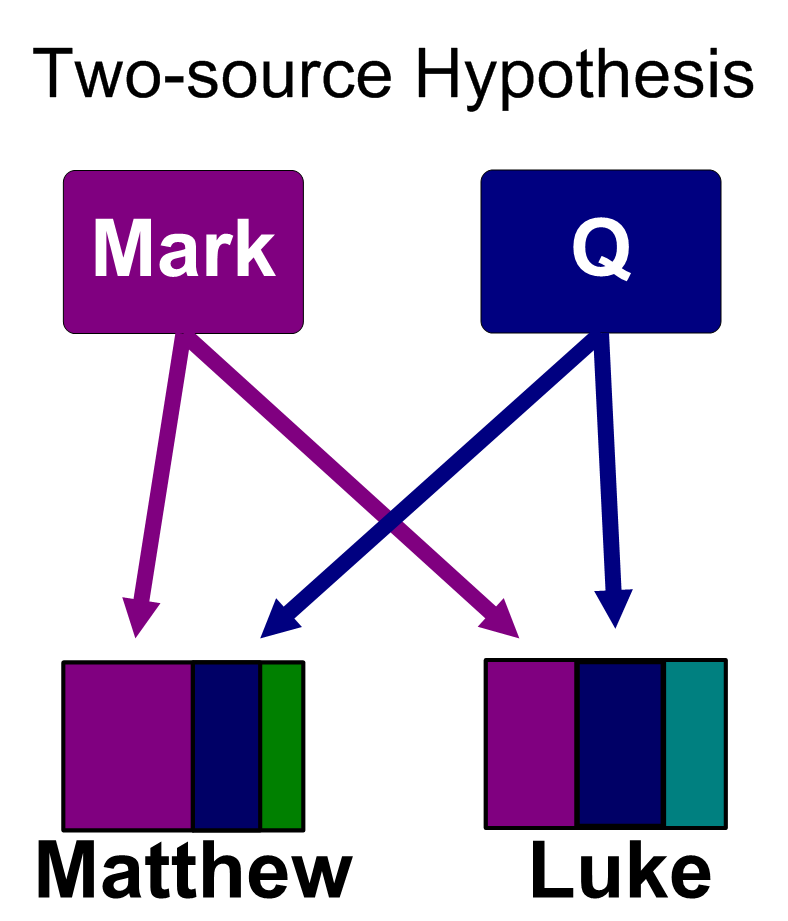
Q is a vapor!
Using Q as a basic story they supposedly invented other parts of the gospel narratives much later. Trouble is: no one has actually found this writing among the many thousands of manuscripts that have been preserved! We have more manuscripts of the New Testament than any other contemporaneous books in Greek or Latin -- thousands. Yet not one of Q!
We have many early translations into Syriac, Coptic Greek, Gothic, Latin etc. Not one of Q!
Heretics made up lots of faked gospels. They survive in their hundreds. There is no manuscript of Q among them. Nor do the heretics use anything like Q! They all look like sectarian fakes!
Conclusion number one: Q did not exist.
Vapor dispersion
That does not stop Q theory being highly popular in seminaries today.
Most churches teach it. Why?
While any sensible person would examine whether this idea is sound before teaching it, modern professors with no scientific training in logic don't. It has the superficiality of truth. It is a veneer only. Certain forms look alike. The problem is they don't make any sense.

Delusion reigns.
This theory, created in 19th century Germany by skeptics and atheists wanting to destroy the primacy of the Bible, is now accepted widely by academics and theologians. By having a 'school' they can all write learned articles about the inconsequential details of a word, while ignoring the falsity of the whole.
It has become more and more popular as the level of general education has fallen. It can be refuted by a better understanding of first century history and a better application of logic.
Flawed logic of the Q theory should make it a target for debunking. But professors teach it rather than debunk it! Students seem unwilling to call out the errant professors. Theory masquerades as fact. Its basic prejudice should also preclude it from claiming impartial truth. Ignoring the historical context of the building of the canon should give Q a failing "D" grade.
When were the Gospels written?
During the lifetime of Jesus. For example his royal and priestly birth was verified and logged in the official family records at both Bethlehem and Nazareth/Sepphoris and the Temple genealogies as well. (Josephus and others describe how comprehensively and minutely these were kept.) Jews and Nazarenes were the most meticulous pedigree keepers, far exceeding any Gentiles.
For kings, tribal leaders and priests and all who wished to enter the Temple, these official records were extensive. They had to show that a child had at least a ten-generation pedigree, each legitimately born of married parents. The marriages (betrothals) and weddings (home-coming) and births had to be witnessed by multiple, proven honest witnesses, all recorded. Matt 1 and Luke 3 show the royal and priestly lineages respectively, (Jesus, James, Joseph and the past and future Temple, chapter 10).
Luke was written soon after 37 CE when the "Most Excellent Theophilus" was in office as Luke 1:1 records. He says also that many had already written histories and biographies of Christ. Luke's gospel (without this dedication) was probably in circulation before late 37 CE, when Theophilus son of Annas became high priest.
What we have is the official or Temple version of Christ's life and work. Matthew was originally written in Hebrew. As such it was also deposited in the Temple archives. So it was written immediately, targeted at a readership of Christ's spectators and followers. It was well known among Jews in Jerusalem and also Hebrew-speakers in the Diaspora, such as Parthia and Babylon. (See the chronology of Temple high priests in chapter 14 on and the high priest list pp239ff in Jesus, James, Joseph and the past and future Temple.)
Pseudo-scientific methodology
Poor logic and distorting facts should make Q theory unacceptable to Biblical students. A valid theory must stand on proven premises. False premises should rule it out before primary consideration. Students need adequate knowledge of the history of Christianity to define the premises. Sadly they do not have this background before they are bamboozled by power-posing professors.
Yet because it requires no historical, logical or scientific knowledge, the superficiality of saying three or four coherent gospel accounts must indicate an original written Q source, has made it popular among some academics.That assumes the disciples weren't capable of recording their own observations separately.
The rationalist /skeptical school is based on two false ideas: the resurrection did not take place and all the prophecies were written after the destruction of the Temple because no one could make such prophecies. Hence the dating of the gospels is all mixed up. The gospels are dated to the 80s, 90s and into the second century!
History confirms the Resurrections.
Hypothesis and conclusion: If the Resurrection is true, then historians would expect a major crisis in the Roman Empire. This would occur in the 30s and 40s when the astounding news was spread around.
It did!
Remember, there were many resurrections among the Jewish Nazarenes and others. Jesus appeared as a transformed being before the Jerusalem city officials and the legions in Jerusalem.. But a number of other dead individuals were raised to physical life again. These resurrected people included Lazarus, the widow of Nain's son but also many, many others. The gospels speak of other resurrections without naming names. They included the saints that were resurrected from their graves at the same time as Jesus, Matt 27:52. Even Josephus speaks of the great miracles of Jesus. Independent accounts of these exist, plus imperial, legal confirmation. Some are republished in Jesus, James, Joseph and the past and future Temple, chapter 32.
Josephus also speaks of the virulent anti-Semitism that took place before these events. The man who was officially responsible was not so much emperor Tiberius but his deputy, Sejanus. He was power-hungry and plotted to usurp Tiberius. When Tiberius found out about it, he carefully dismantled the plot and had Sejanus executed. He then looked at the evidence of the Resurrection, including reports from Pilate, and agreed it had taken place. He proclaimed Jesus a god! And he forbade Romans to persecute any of his followers on pain of death.
History proves armchair atheists wrong!
This shows that, contrary to armchair atheists, the proofs of the Resurrections were in full circulation, right after the events of 30 CE. There is no need to hypothesize that Christianity was some sort of minor movement of his dispirited followers who spread rumors of his teachings which somehow spread over the course of a century or two.
What happened after Tiberius died in 37 CE adds more proof that the gospels were all well-known among imperial circles. They were not only well-known but feared. The Resurrection of a Jewish King was distasteful to imperial Romans, because they despised the Jews. Worse. The Jews did not believe in the Roman Pantheon of Jupiter, Minerva and Mars etc. This Jewish God was better than all of them because contemporary Romans and others knew that the Roman Governor Pilate and the legions had all witnessed the resurrection of Jesus. They had probably interrogated the others who had been resurrected from their graves. The documents we have of later Caesars all seem to agree with that.
What of Tiberius's successor, Gaius Caligula? He was faced with the crux of the crisis. Either he accepted Tiberius's position and inevitable decline of the Roman gods and the Roman Empire or he had to give some proof of his own power above that of the Jews.
Caligula tries to be Christ.
In effect Caligula mobilized the whole Roman Empire against the Christians in a show of force and imperial power. Christ said he would come again to the Temple and an Abomination would also try to seize power. Caligula 37- 41 CE said he was god of the world, Jupiter himself. In his mind Jupiter was the king of the gods.

The records of Philo, Josephus and Roman historians show that Caligula wanted as Jupiter to set up his capital and military HQ in God's Temple in Jerusalem.
He would first defile it with a huge golden idol of Jupiter in the Holy of Holies. That would not only cause a Jewish insurrection against him. It would risk war with Jews and Israelites around the entirety of the Empire.
Caligula told his supreme military commander in the East, Petronius in Syria, to be ready for war on two fronts, inside and outside the Empire. He would massacre all disobedient Jews in Israel and elsewhere. Even worse this act would set ablaze a world war with the mighty Parthian Empire to the East. Many were Israelite exiles who had paid for the Temple reconstruction. Petronius set half his legionary forces against possible Parthian attack.
Did Caligula take Parthia too lightly because of their restraint during a half-century of peace? Or did he feel the war with Rome's greatest super-power foe plus eradication of all Jews and Nazarenes was necessary to resolve his Christ problem, that would inevitably entail Rome's pagan demise?
Philo describes this in detail. Parthia had already defeated Roman legions under Rome's greatest generals multiple times (chart summary in Jesus, James, Joseph, p372). It was only when Tiberius agreed to peace with Parthia that the Temple had been rebuilt in 20 BCE. This had brought a great and prosperous peace to Rome. Among other benefits was that the Silk Road to China was open to trade.
Roman gods die! So does Caligula!
Caligula wanted to risk all this in order to sit in the Temple of God. This was not madness, but power politics and egomania. Caligula risked the entire Empire on the idea that the Resurrection was false and his legions mightier than God. He did so because the gospels and many other proofs were circulating in Rome in 37-41 CE. Unless he defiled the Temple, the "Jewish God" would triumph over Roman gods and its emperor.
Caligula was well informed about the logical outcome of the Resurrection and the dangers for the Empire. So was the Senate. It refused to acknowledge the death of the Roman gods. The Resurrection showed they were all false gods. The Senate said they were in control of naming the gods. The Resurrection showed they were not. The world had thousands of expert witnesses saying the Resurrection was a real event.
Caligula tried to stop the inevitable rot and decay of the pantheon.
He declared he was the almighty Jupiter. He would kill any who refused to worship him. He would sit in God's Temple in Jerusalem as the immortal, supreme god himself! But he was attacked by his own guards! He died as he was about to set off for the East.
"To change God into a man is more easily done, than to change a man into God!" wrote Philo. (Jesus, James, Joseph, p 673).
The whole Roman pantheon that had existed for a thousand years collapsed in the first and second centuries. The world rejected Jupiter/ Zeus, Mars, Diana etc as false and fraudulent. They then turned their worship to new gods including the Sun. That deistic decimation wasn't done by Christians whispering to each other and passing on anonymous screeds. The gospels were written, not in a professorial study, but amid the most dramatic events of Roman history.
Circular arguments
Proponents of Q theory are in danger of falling into the vortex of a circular argument.
The theoretician Kloppenborg came up with the Q3 theory with three levels of Q documents in the gospels. He defined Q1 as the earliest with only the Sayings of Jesus. He excluded by his definition anything other than these contextless words. Hence it would not have any reference to the aspects that are missing. Kloppenborg and friends did not like these other bits for his Q1. The second layer that later, so-called editors added was the prophecies. He called the prophecies Q2. Then the historical facts and geography were added. He called this supposedly later-written context, Q3. This mythical third layer of editing arose much later as the framework we see in the last redaction of MSS. Who wrote it? Unknown editors added this in a mysterious, still hypothetical document, that no one has ever seen.
If you believe this, consider my equally fictitious claim that I really wrote Q3 of Shakespeare and I claim all copyright on his plays! Or maybe Moby-Dick.
Q theory of Moby-Dick
I could do the same for a theory of the Q source in Moby-Dick by saying Herman Melville originally had two sources, Q1 without whales and Q2 about whales. Then I could say: "I'm glad Herman did not originally believe in killing whales! Q1 proves it." People could have great fun separating out the jigsaw pieces of which belong to Q1 and Q2.
The Q theory assumes that the earliest NT written source dates from the 50s. Not true. The Jews and the Romans had stenographers that recorded important speeches, especially those leading to trials or theological discussions in the Temple and elsewhere. The historical data and context of the gospels (including attempted ethnocide of Christians/ Nazarenes and Jews by Caligula, Nero and Flavians) are ignored in Q theory.
Naming the Gospels
The complementary idea is that none of the gospels was written by people called Matthew, Mark, Luke and John. They were all anonymous at first for a century or so. Unfortunately for these novelist-theorists facts of history make nonsense of their armchair imaginations. There are no anonymous manuscripts. If there had been anonymous MSS circulating for decades, we would expect see scores of invented attributed authors (provided Christians were dishonest enough to invent authors for anonymous MSS). Prof Brant Pitre gives an intelligent and logical Roman Catholic rebuttal of modern skepticism in the theology he was taught and originally accepted at his universities at https://www.youtube.com/watch?v=NzQqYtJciOE Good to see a Roman Catholic academic going back to the Jewish roots of Christianity. Worth watching!


