What year was Jesus born? Today a reader will find a range of dates but this was not always the case. In the time most close to the actual birth there was little doubt as to what year Jesus was born. Everyone, with hardly any exception, was unanimous. What was that year? When and why did all the confused scholarship about the date arise, so that today few people really can put a finger on the year?
No year Zero!
Most people know that it wasn't a Year Zero. Why? Because the year zero does not exist in the system of BC and AD (Before Christ and Anno Domini= year of our Lord).
The system of dating goes from one BC and then directly to one AD. It does not pass by year Zero. It is not like mathematics where a graph has an origin of zero and to the left is -1 and to the right is +1.
That is why most historians nowadays use the system of
Common Era where no implications about the year of the birth of Jesus are involved. That's because the BC/ AD system was introduced in Rome by a learned, multilingual Scythian monk,
Dionysius Exiguus, (c470-c544) who got his arithmetic slightly wrong.
However the CE system makes little difference to the dates as 1999 AD = 1999 CE and 444 BC = 444 BCE (Before the Common Era).
The Astronomer Johannes Kepler is generally credited with starting the system of Common Era as it was necessary for years to be properly identified without ambiguity when scientists were discussing the years when planets and comets approached the earth in their orbits.
When was Jesus born?
It would have been simpler for scientists and historians to correct Dionysius's mathematics and leave it at that. However there was still a slight disagreement among specialists about which year that was.
All the early chroniclers and historians were in agreement that the birth happened within a very few years of around 2 or 3 BCE. There are slight variations as various calendar systems were used in different locations. Some calendars begin in January, others in August or October. The Hebrew calendar begins in the autumnal month of Tishrei, based on a 19 year cycle that is automatically adjusted to the seasons.
Here's what the various authorities said, adjusted to our calendar:
Irenaeus (late 2nd century) 41st year of Augustus = Aug 3 to Aug 2 BCE
Tertullian c 200 41st year of Augustus = Aug 3 to Aug 2 BCE
Origen (early third century) 41st year of Augustus = Aug 3 to Aug 2 BCE
Clement of Alexandria (c 200) 28 years after Cleopatra's death = Aug 3 to Aug 2 BCE
Julius Africanus (c 200) . 2nd yr 194 Olympics . = Oct 3 to Sept 2 BCE
Hippolytus of Rome 2nd yr 194 Olympics . = Oct 3 to Sept 2 BCE
Eusebius (c 300) 42 year of Augustus from 44 = 2 BCE
28 yrs after Cleopatra's death = 2 BCE
3rd yr of 194 Olympics = 2 BCE
42 yr from 43 BCE = 2 BCE
Epiphanius c400 3rd yr of 194 Olympics = 2 BCE
42 yr from 43 BCE = 2 BCE
Dionysius Exiguus early 500s 1 BCE
Appolinarius of Laodicea = 2 BCE
Paulus
Orosius end 42 yr Augustus = 2 BCE
752 AUC = 2 BCE
Hippolytus of Thebes 9th century 42 yr of Augustus
43 yr of Augustus = 2/3 BCE
These dates are all fairly consistent but a year or two off from the date of
Dionysius. He had translated from Greek to Latin the canons of the synods from Nicea (325) to Chalcedon (451) giving the new doctrines of the centralised Gentile church based in Constantinople. The
computation of the
Easter Table was a central part of his work. It was based on Egyptian calculations.
The
annual date for Easter was a sensitive matter for the Roman church. The pagan Roman Pontifex Maximus had authority over the calendar and public festivals of the gods. From Julius Caesar on, it was passed on as part of the powers of all Roman emperors. In the late fourth century Emperor Gratian, now nominally Christian, refused the title as being too pagan. The bishop of Rome (pope)
Damasus took up the title.
Easter was the church's alternative to the biblical Passover. One of the directives was not to make the Christian festival coincide with the biblical date but exactly the opposite. To make sure that it didn't! Eventually the Easter calculation became the standard one of today, although the Orthodox retain a difference because of the Gregorian calendar adjustment.
The chronology of Dionysius had to fit in with what was Constantine's now centuries-old, well-established but falsified doctrine of Sunday-worship. His aim was to overturn the Hebrew calendar and apply one that allowed both Sunday worship and the pagan Easter tradition to replace the biblical Passover.
A harmony of the Gospels shows that Jesus was crucified on the Preparation Day of the Festival Sabbath of Unleavened Bread, that is Wednesday. The biblical holy days do not fall on the same days each year. It was obviously not the Preparation for the weekly Sabbath, Friday. He rose after three days and three nights in the tomb. The Resurrection is recorded as happening as the (weekly) Sabbath ended towards the first day of the week. These dates can be calculated to show the year with these characteristics. Hence the year of the Crucifixion is fixed mathematically. Then it is
simple Hebrew mathematics to work back to the year of Christ's birth.
As the Dionysius Easter Table was also based on a mathematical 19-year cycle, it could be calculated which years coincided exactly with the new Easter doctrine (with its Friday crucifixion and Sunday resurrection, itself difficult to reconcile with a three days and three nights period of the NT) around 30s CE.
Dionysius also tried to simplify the complicated system of dating that existed in Rome, based on the consulates in power each year. Dionysius also made a revolutionary innovation that few of his contemporaries probably understood. He used the term zero (Latin
nulla or
nihil). There was no zero in the Roman mathematics system. It was not until the Middle Ages that the idea of zero (originating from India) came into use.
These may be the main reasons why his dating was a little bit off. It is significant that his dating system was the one that was used by the Roman Catholic '
missionaries' in Britain after the arrival the pope's emissary Augustine around 400 CE. In Britain the Roman churchmen who attempted to convert the Anglo-Saxons found that the native Britons were keeping their Christian festivals on a different day. Passover was kept like Jews and Nazarenes on the fourteenth day of the first spring month. The Britons had been doing so for hundreds of years before Augustine arrived. With the spread of the Roman doctrines, the Easter computation, reinforced by the work of Bede, became that recognised from East to West.
The Dionysius system of dating was common during the thousand years of Roman control of books and learning.
With the onset of printing and the publishing of the Bible in native languages people began to question intensely why this date was taken as correct.
Science and historical research began to probe the facts and offer other solutions.
The 4 BCE error
How did Christian scholars move from the dates of both Dionysius and just about all early writers and historians of the first centuries to what is found in many Bibles? According to the King James version, Christ was born in 4 BCE. An even broader range of dates is now proposed and the dates of all the early writers is treated as error. Why?
Firstly, let us explore why the KJV came up with 4 BCE. This was a predominant date around the time the Bible was published in English. How was the earlier date eliminated?
The answer is a mixture of good science and bad history.
This date derived from one of Europe's greatest scientists,
Johannes Kepler, the astronomer and a Polish historian. By careful observation and mathematics Kepler was able to deduce the
conjunction of major planets such as Jupiter, Saturn and Mars. He thought that this close visual encounter of the planets might have accounted for the
Bethlehem Star. His calculations gave him a date of around 22 June in 7 BCE.
If the star appeared in the East, he argued, the birth might have occurred a year or two later, 6 or 5 BCE. He ruled out the theory that it could have been a comet, as Origen had surmised. In his book he argued that the Magi came from pagan Chaldea and applied Chaldean techniques for interpreting the heavenly phenomenon. God provided the material events for the Chaldeans to this conclusion. he said it must be a conjunction of the major planets.
This rested on two or more bits of guesswork: what did the gospels mean by a star? How could a star seen in the East in Parthia then stand over a house in Bethlehem? What principles of astronomy did
ancient Parthian Magi use? Isaiah 47:17 and other scriptures make clear there is a right and wrong interpretation of '
astrology'. How were the stars tied into biblical prophecy? Was what was mentioned related to the movement of the planets, the usual focus of such studies?
While he was observing a conjunction in 1605 a bright new star appeared, a
nova stella. Maybe this Nova was a solution.
If the mechanics of the solar system showed a different date from 2/3 BCE, how could this be justified? Kepler relied on a Polish historian
Laurentius Suslyga.
While reflecting on the problem, Kepler found his book, calling for a revision of the datings, in a shop in Graz. Examining secular history, he challenged the traditional dating of Dionysius. Suslyga came up with a date of 4 BCE or earlier. But Kepler went further.
First, how did Suslyga come to the date of 4 BCE?
Enter Philip and Julias
Suslyga was among the first to suggest that the date of Herod's death must have been no later than 4 BCE.
His argument revolves around a son of Herod called Philip, born of his fifth wife, Cleopatra of Jerusalem.
Suslyga's argument involved the town of Bethsaida. Philip had renamed Bethsaida as Julias after Julia, the daughter of Augustus, Suslyga maintained. But Augustus exiled her in 2 BCE so Philip would have had to come up with the idea well before that, when she was in favour.
So Herod must have died well before that so his son Philip could reign in part of his territory afterwards. This seemed a good argument for Kepler at the time. But modern scholars now believe this scheme of things is not necessarily so. Augustus also gave Julian honours to his wife Livia, and renamed her Julia to emphasise a connection with Julius Caesar and the imperial family. So Philip could have renamed the town of Bethsaida, Julias, at any time up to the time of her death in 29 CE. In the second century the geographer Claudius Ptolemy identified the town of Julias with Livia.
Conclusion: We can conclude that Suslyga and Kepler were most probably wrong. There is no evidence that the Julias argument is correct. Rather the reverse. There is no evidence that Kepler's idea of a conjunction of Jupiter and Saturn is correct. Two planets can always be seen separately; over a period of a day or two it is even more obvious. A conjunction of several planets does not look like a single star. Kepler was basing himself on pagan Chaldean astrology and there is no evidence that this (usually condemned system in the Bible) is relevant here. Nor does it take a year or two for a caravan of Magi to travel from Chaldea to Jerusalem. The Nova idea is also a theory without evidence, because it presupposes the Bethlehem star was a nova.
Search for the eclipses
A new line of argument revolves around eclipses in history at the time of Jesus. This helped to solidify what is a common belief that the date was 4 BCE.
But this includes several errors that logically would eliminate them from consideration.
Eclipses of the moon are also predictable both into the future but back in the past.
Why are eclipses important?
This is where the Jewish historian, Flavius Josephus, enters the scene. He describes how Herod was in Jericho suffering and dying from an atrocious disease. He also describes quite a number of events including killings of Jews that fought for the purity of the Temple, in expectation of the Messiah.
All these events need to be taken into consideration as they mark temporal dates in sequence.
He died and then his body was brought in a solemn procession from Jericho. to Jerusalem That year was marked by a remarkable eclipse of the moon over the land of Israel.
Which was it?
The New Testament also gives a quite clear timing of events in the Gospels. Christ was born during the reign of Herod the Great. So if we have the exact dates of his reign, we know they must include the birth of Jesus. But some while after his birth Herod ordered the massacre of infants from the north of Jerusalem to the south. This happened soon after the Parthian Magi arrived to celebrate the birth of Israel's Messiah. The Greek NT text says they visited Jesus in his Bethlehem home when he was then a toddler (
paidion), that is, a year or two old.
So the birth of Jesus was a year or two before Herod died.
When did he die? When was the eclipse?
From the work of mathematical astronomers like Kepler, we now know the exact days when eclipses happened in the Holy Land from 7 BCE to 1 BCE.
The dates are:
- 23 March 5 BCE
- 15 September 5 BCE
- 13 March 4 BCE
- 10 January 1 BCE.
By collating all facts and events that Josephus mentions the two early dates can be eliminated. These facts include killing of pious Jews, the dates of the Hebrew festivals, Herod's death and when it was reported in Rome (a distance of 3400 sea mile round trip) and the time taken for the long royal mourning procession to move from Jericho to Jerusalem. A closer examination points to a winter eclipse: Jericho would not be too fiercely hot for the dying king. He would not reside there in summer. Temperature in winter was moderate.
Conclusion: Taking together all the reported events of Josephus and the Gospels, together with a biblical interpretation of the astronomy of Revelation 12, one date is the inevitable candidate above all others. Revelation describes the birth of Christ in astronomical terms that people at the time could understand.
Eternal God, creator of the Universe
Humans are subject to error and tempted by deliberate deceit. Humans cannot muck with movement of the planets, comets and stars. That was the reason that Kepler, Newton, Whiston and other believing scientists tried to determine what, when and where was the Star of Bethlehem.
The heavens have an extraordinary, clear and unambiguous message. But what is it? We should not seek it in pagan, Chaldean astrology.

What does the Bible say? What is the configuration of the heavens in the autumn of 3/2 BCE?
Astronomers in the past could work this out. Many people in the early centuries were far more skilled and literate in astronomy and its real significance than people today -- in spite of so-called popular astrologers.
They looked at the sky at night and knew the stars and the movements.
But how do you see what was happening way back in the past?
You can also this ancient stellar display in the heavens at a planetarium when they set the mechanism back 2000 years.
Now with the help of the computer and
software it is possible for anyone at home to see exactly the movement of the planets back into the distant past.
What did the night sky look like in 3/2 BCE?
It is an extraordinary fact, as
Dr Ernest L Martin points out, that
- on only one day in 3 BCE was the moon under the feet of the constellation of Virgo, the virgin and the sun 'clothed' her.
- It was when it was the first crescent of the New Moon.
- It occurred on 11 September.
- It remained there for only a few hours.
Click the link
here to have a description of the Ancient Astronomy of this time by Dr Michael Heiser.
One reason people observed the stars was that it was religiously significant because observation of the New Moon was essential to define months and proclaim the New Year. What is even more extraordinary is that 11 September was the beginning of the Feast of Trumpets in the Hebrew calendar. Revelation 12:
'
And there appeared a great wonder in the heaven; a woman clothed with the sun and the moon under her feet, and upon her head a crown of twelve stars.'
This year is also confirmed by Luke's statement that Jesus was '
about thirty years old' when he began his work as chief priest and teacher in the Temple. This has to be understood in relation to the Hebrew inclusive arithmetic system and the Jewish secular new year (common through the eastern Roman Empire). It is also defined by the known dates for the reconstruction of the Temple by Simon Boethus under Herod the Great.
The date of the
birth of Jesus is
1st Tishrei in year 3 BCE in the autumn.
This fits all the criteria of
- historical events in the NT and Josephus
- Hebrew chronology
- Hebrew festivals
- Hebrew interpretation of the movement of the planets in 3 BCE,
- The near unanimous report of nearly all early writers of the first centuries.
The heavens don't lie.
Why do Historians reject 1 BCE?
The scholars, have however, rejected the eclipse of January 1 BCE and plumbed for 4 BCE.
Why?
They are convinced (or have convinced themselves) that Herod's death took place in 4 BCE. That would eliminate any recourse to the eclipse of 1 BCE as the one mentioned in Josephus. It would also cause problems with the chronologies about Jesus's thirty years and many other events in order in Josephus. It flies in the face of both secular and religious writers of the early years.
However historians today are often adamant (and sometimes aggressively supportive) about the idea that Jesus must have been born in or before 4 BCE.
Why?
Herod and Philip
Did Herod die after the spectacular total eclipse of the moon in 1 BCE or after the partial one of 4 BCE? Why does historians' choice of the year for Herod's death fall nowadays on 4 BCE? That eliminates the 1 BCE date as Jesus was born when he was alive. But is this correct? How do scholars come up with the date? Josephus mentions only one eclipse in all his long and detailed writings of history. (Hundreds took place in the course of centuries that he describes.) So it must be significant.
Is Josephus's eclipse a partial one with the shadow of the earth covering barely a third of the moon, just 37%, or a total one blacking it out? How do we decide?
The simple answer is to see how today's historians take it from a passage they read in Josephus's
Antiquities book 18 about Herod's son Philip. He reigned in the eastern part of the Holy Land, the
Tetrarchy of Batanaea and rugged Trachonitis (modern day Golan, parts of Syria and Jordan).
Josephus says, in the English translation of
Antiquities, that Philip died in the twentieth year of Tiberius after ruling 37 years. The twentieth year of Tiberius is 34 CE. Therefore 37 years back would be the start of his reign, the year thatHerod died. Remembering there is no year zero, that should be 4 BCE.
Historic Detectives
Simple and concise! What could be wrong with this arithmetic? Facts are not always obvious. The detective work of David W Beyer started to reveal some hidden or rather buried clues. The first trace was published by W E Filmer in an article in 1966 in the
Journal of Theological Studies. Filmer reported that divergent chronologies about the reign of Philip were noted in the nineteenth century. They had disappeared from scholarly view. In a 1798 dissertation, a monk, Molkenbuhr, reported seeing several Josephus manuscripts where the text read '
the twenty-second year of Tiberius.' Filmer remarked that this was the last remaining obstacle for the acceptance of Herod's death in 1 BCE. The existence of such manuscripts would make it difficult to argue that Herod died in 4 BCE.
Beyer went on the hunt for the manuscripts.
The evidence was in a fairly obvious place. In the British Library Beyer found 46 editions of Josephus published before 1700. Of these the majority -- twenty-seven -- had the reading of '
twenty-second year of Tiberius.' Of these 27, not a single edition published before 1544 had the reading '
twentieth year of Tiberius.' This is of crucial importance.
In 1994 Beyer examined the copies of Josephus in the Library of Congress. Five more editions were found having '
twenty-second year of Tiberius'. Among the others none published before 1544 supported the reading '
twentieth year of Tiberius.'
Beyer realised that the year 1544 was of some importance. It was the date of the first printing of the Greek text of
Antiquities. Froben working in Basel accomplished the monumental task of printing the Greek text. Unfortunately for the understanding of Philip's reign, it became the universal standard. Four years later a Latin version based on it was published reinforcing the reading. By 1550 any alternative reading to '
twenty years' were almost non-existent. In 1605 Laurence Suslyga published his dissertation on chronology, opting for the date of 4 BCE or earlier. But an edition in the British Library of Venice dated 1608 shows that some printers followed Greek manuscripts and not the printed Froben works.
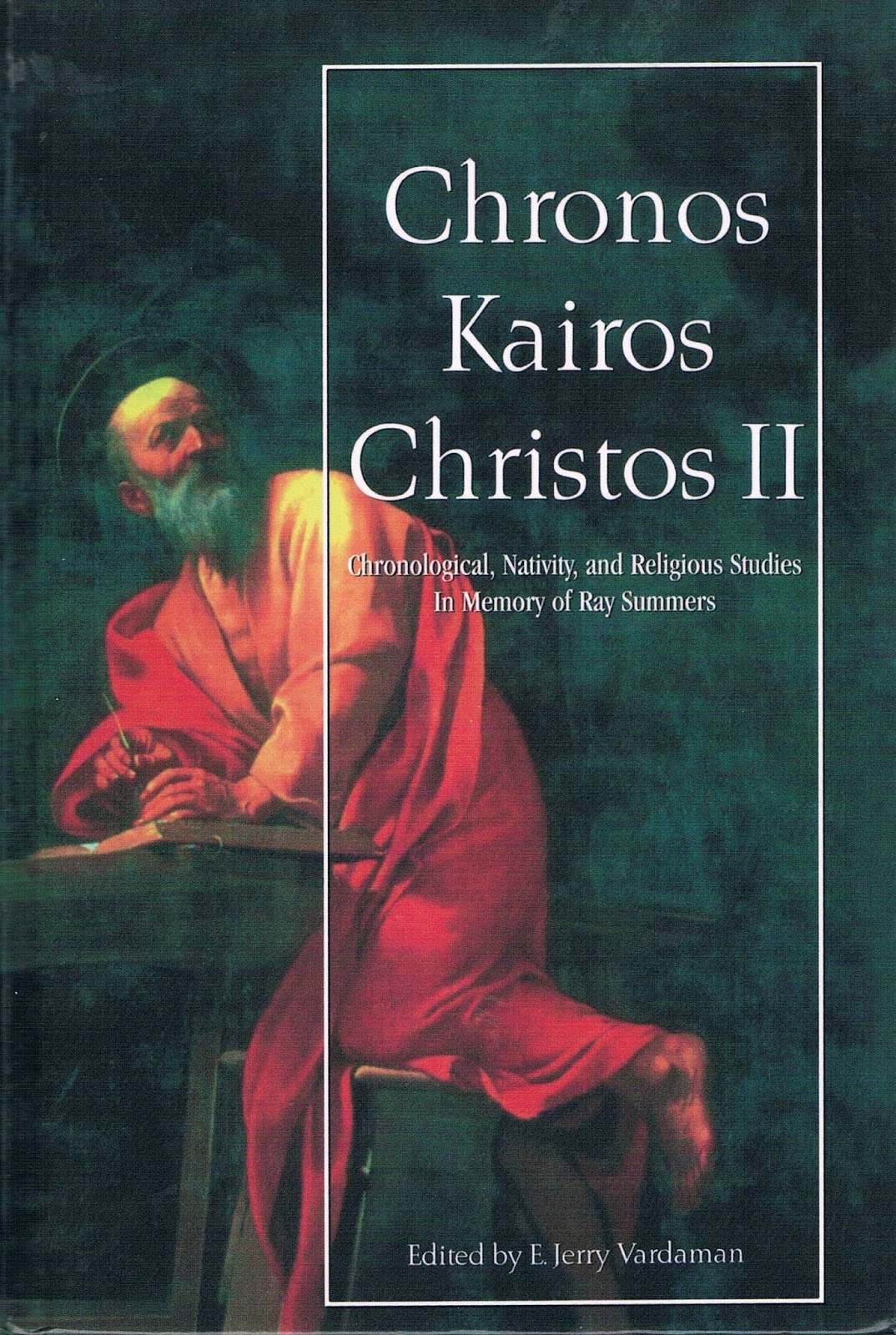
Writing in the Festschrift study,
Chronos, Kairos Christos II, Beyer says the cover argument for 4 BCE is no longer tenable. These early more authoritative manuscripts show Philip reigned to 36 CE. With a reign of 37 years, he must have begun his rule in 1 BCE. And this must be the year Herod died.
Manuscript mentions

Beyer lists a dozen manuscripts from the 12th century up to the period of printing. All of them have the 22 years of Tiberius. There is some variation about the length of Philip's rule. His accession to the throne was in troubled times. Most say that his reign was 32 years -- indicating that his reign was not established until some years after he was legally made the ruler. But the point is clear from these manuscripts and four early printed books in the British Library: Herod did not die in 4 BCE but in 1 BCE.
Early Manuscripts all with 22 years and 32 years for his reign
Royal 13 D VII 12th century
Additional 22, 860 13th century
Additional 15, 280 13th century
Harley 5116 ?
Harley 3883 1 ?
Harley 4962 14th- 15th century
Harley 3699 1478/ 1469?
Arundel 94fl ?
Printed Editions (first stage) all with 22 years of Tiberius and 32 years for his reign
IC 50150 1475
IC 9806 1480?
IC 9807 1480?
4515 f9 1511 (Paris)
Printed Editions (second stage) with 22 years of Tiberius and 35 years of Philip's reign
C 13 d9 1470
(G) 8333 . 1470?
IB 20662 1481 Venice
IB 23112 1486 Venice
IB 23201 1499 Venice
C 55 hl 1510 Venice
L 22 b5 1514, 13
Third and fourth stage. Eight other editions printed in various locations like Basel, Strasbourg and Venice give 22nd year of Tiberius and various durations for Philip's reign from 22 to 32 or 35 years.
In the fifth stage, Beyer lists two dozen printed editions from 1544 to 1701. Three Venice editions have the 22nd year of Tiberius. All the rest have the 20th year.
In the Library of Congress, five editions from 1470 to 1481 (Augsburg and Venice) give the 22nd years of Tiberius. Four from 1559 to 1597 give the 20th year of Tiberius.
In the Renaissance and early Reform period Greek manuscripts became the treasures of the libraries of Venice and Florence where a free press was allowed. Many printers from Germany and northern Europe set up their presses there.
In 1726 the Oxford scholar John Hudson published his translation into Latin and his notes of the Greek text of Josephus by Siegbert Havercamp. The text has the 20th year of Tiberius but with an extensive note that some versions had 22nd.
The Latin translation attributed to Rufinus (who lived at the time of Jerome around 400) has the translation '
twenty-second year of Tiberius'. This clearly used the Greek texts extant at the time.
However the main text has that of Froben '
twenty years'.
This is the text that all English translators use -- with the 20th year implying that Herod died in 4 BCE.
William Whiston, author of the most widespread version of the Works of Josephus, goes along with this text. He even adds a note supporting it.
Beyer says that a proper dating of Herod's death date is essential for understanding the events in the Holy Land around the time of Jesus. Augustus received a special title
Pater Patriae (Father of the Fatherland) around the time of the 750th anniversary of the founding of the city of Rome. It celebrated the fact that in 2/3 BCE the Roman empire was at peace.
However, it is clear that after the death of Herod a vicious civil war erupted in Israel. Herod had killed Jewish scholars who had defended the Temple. He planned to kill one member of each Jewish family so the whole nation would mourn his passing.
That did not happen but later that year a civil war broke out. One great issue was the correct dates and celebration of Passover and Pentecost. Two great Jewish scholars, Judas and Matthias, knowing that Herod was dying, pulled down the massive golden eagle, symbol of Rome, that defiled the Temple.
Herod was alive enough to deprive the high priest (also called Matthias but of Boethus) of his office and burn the other Matthias, son of Margalothus and many of his colleagues alive.
'And that very night,' says Josephus, 'there was an eclipse of the moon.' Antiq 17.167.
At the Pentecost after Herod's death of that year of 1 BCE, the righteous high priest of Simon of Boethus and his family (related to Mariam (Mary), Joseph and his son Jesus) were all removed. (Joseph had officiated once as a Mishnah High Priest (
cohen moreh) at a previous Day of Atonement.) The Boethusian family was replaced by the '
sons of Seth' whose offspring included Annas and Theophilus of the NT. Caiaphas was the son-in-law of Annas.
The Jewish people rose in rebellion once Herod was dead and demanded Archelaus that the purer high priesthood be restored. In vain. Archelaus's position had not been confirmed by Rome. Jerusalem was in turmoil and fighting. '
Ten thousand' other disturbances broke out in Judea,
Antiq 17.269. Robber bands roamed the country as it fell into disorder.
Varus was president of Syria with supreme powers in charge of Rome's eastern possessions.
The Pentecost, after Herod's death, saw increasing disturbances.
That is when Varus acted. There was one legion in the country. He brought in two others and four troops of horsemen. He also drew on several auxiliary forces that were supplied by kings and tetrarchs (286). The capital city of Galilee, Sepphoris, of which Nazareth is a suburb, and several other cities were burnt to the ground. Two thousand Jews were crucified and 30,000 Jews sold into slavery (17.295) before order was restored.
This major war with the Jews could not have happened when Augustus was being celebrated as bringing peace to the whole empire. It is known as the War of Varus (
Antiquities bk 17.10-11 250-). It is also known that Philip received the title of Tetrarch after this war had ended. That accounts for the some of the doubts about when he started his reign, either legally (
de jure) or in practice (
de facto).
But it also renders impossible the supposed 4 BCE chronology with Philip taking over immediately Herod died.
'Ernest L Martin has solidly demonstrated that the conclusion of that major conflict occurred in late 1 BC,' Beyer wrote. 'Thus Philip's appointment as tetrarch most likely took place shortly thereafter, in 1 AD. This is the de jure date referred to by the twenty-two/thirty-five chronology. The tremendous political instability of the entire region very likely prevented Philip rom assuming full administrative authority for some of the period of time. This is by no means unusual for it was also the case with his own father. Herod the Great was declared king by Caesar Augustus in 39 BC but assumed de facto control with the capture of Jerusalem in 36 BC. The thirty-two year tenure provided by the twelfth- to fifteenth century texts mark the de facto date of Philip's reign beginning in AD 4.'
Coins of Philip show that his
de jure date of accession is antedated to 1 BCE just after the death of Herod.
Let's hope that the penny drops more widely in the scholarly community and for the public in general. The year of the birth of Jesus was 1 Tishrei in the autumn of 3/2 BCE.


.jpg)
.jpg)