Showing posts with label Sejanus. Show all posts

Wednesday, April 13, 2022

What makes Luke's Gospel unique? Caligula and the authenticated Temple archives!

Luke's Gospel is a record addressed to the High Priest in Jerusalem. It can be shown that it was the time when Gaius Caligula was the emperor. He wanted to destroy all Jews and followers of Christ. 

The book was designed to provide undeniable facts to a political and religious leader of the Jews. The high priest was a pawn of Rome, chosen by Rome to act in Rome's interests to control the Jews. Luke's book, however, provided fact after fact, known to all Jews and believers, that showed why Rome's policy was dead wrong. Furthermore, it showed why the high priest in this case should be acting against the well-known misdeeds of his priestly father and brother, also recorded in the gospels.  

The book is addressed to “Most Excellent Theophilus” chapter 1:3. He was the ethnarch (Roman designated high priest and native ruler). He  ruled as high priest from 37 to 41 CE. He is mentioned in Josephus as the son of Annas of the NT.

This title (kratiste) shows the book was written in this period of intense persecution. The evangelisation of the world had started with force. Areas like Britain outside the empire became a safe haven. 

Emperor Tiberius had recognized that Christ must be a god as he had reports and dispatches showing that the Resurrection had taken place. The Senate objected to this divine status. They said that in Roman law the Senate alone had the legal right to define who was a god. So Tiberius forbade anyone to persecute believers while he lived.

Caligula, the would-be 'god'

Then Caligula had Tiberius killed in 37 CE and became Emperor Gaius. Caligula saw the danger to the whole infrastructure of Rome. It was based on paganism. Paganism was based on the whim of men in the Senate. Its fall was inevitable. It was only a question of time, not logic. 

Romans were confronted with genuine miracles and a genuine resurrection from the dead, followed by many others, Matt 27:52.

And the tombs were opened and many bodies of the saints who had fallen asleep arose, and came out of their graves after his resurrection and went into the holy city, and appeared to many.  

Caligula's single-mindedness to act is described as madness. Flavius Josephus, a eye witness of events, says the emperor had a madness of hubris, an overpowering insolent pride, Antiquities 19,1. Its malevolent power 'extended through all the earth and sea.' It 'filled the empire with more evil than history has ever known.

Among all the earth, Caligula said, 'the Jews and their institutions are my worst enemies.' Leg, 256. Why?

Philo, the Jew of Alexandria, says Caligula was 'beside himself with vanity, not only saying but thinking he was god. He then found among the Greeks or the outside world no people fitted better than the Alexandrians to confirm this unmeasured passion craving for what was beyond mankind's nature.' (Leg 162.) 

What motivated such extremism? Why did the Alexandrian Greeks act so enthusiastically? The core of this madness was a desire for absolute autocracy. That reflected his ancestor, dictator Julius Caesar. 

Caligula wanted to set himself up as the indisputable political and religious head of the entire empire. He drank precious pearls dissolved in his drinks; he ate golden bread and golden meat. He had sex with everyone from the prostitute Pyrallis to almost every woman of rank in Rome. They were all his sex slaves. He had homosexual relations with many men. He had incest with his sisters. (Suetonius: Gaius 36.)

Note: his contemporaries considered he increasingly developed his character of inordinate pride, hubris. It was applauded by some groups and nations. It was not seen as a clinical or medical conditions as recently some writers diagnose centuries after the event to explain it away: glandular disorder, hyperthyroidism, interictal temporal lobe epilepsy, encephalitis, schizoid illness etc.

What was his motivation for all this?

Despot or Absolute Sovereign?

Caligula's dilemma may be summed up in one Greek word. That word is Despotes. It means Absolute Sovereign. It is used of a head of a household which had slaves. The slaves' lives and treatment including torture and death were totally in his hands. Roman law gave a master of slaves absolute control as objects and possessions.

The term was not used between freemen. The officers of Caesar might be addressed as lord, kurios in Greek, but not despotes. That term was reserved to the Caesar Gaius, the only one in this period. Why only one? Because the word despotes was usually confined to the supreme god of the universe, the Creator of all.

To call someone despotes implied that all other creatures were his slaves, obedient subjects, bought and owned by him. 

Augustus then Tiberius simply called themselves first citizen, princeps. They said they were chief priest of religion (Pontifex Maximus) or recalled they had been consul, the chief magistrate. That was not enough for Caligula. He insisted he be referred to as despotes, Absolute Master, by Romans, his officers and even his friends, like king Herod Agrippa.

Jews avoided the term despotes whenever they could. That would be confounding the power and dignity of Almighty God with a pagan.

There was one major exception. Jews applied the title despotes to one of their own. Inside the Temple of Jerusalem, the chief priest (not the high priest) was referred to as despotes or oikodespotes (Absolute Sovereign of the House). The Temple was a City-State and the person in control of all its thousands of guards and the high priests was the Chief Priest. He was Teacher of the high priests and Levites. All had to obey him as he spoke the oracles of the living God.

Jesus, the Anointed Chief Priest, was addressed by these titles and he  refers to himself as oikodespotes, Luke 13:25, Matt 10:25, Luke 14:21. Peter and Jude in the NT refer to him as despotes, Absolute Master (2Pet 2:1 and Jude 4). Gentile converts also in Rome referred to Jesus as Despotes (1 Clement 40). In history the larger family of Jesus and his brothers and sisters is referred to as the desposyni, blood relatives of Jesus, the despotes

When a Jew or Nazarene or a gentile convert referred to Jesus, he said despotes. They had been bought back, redeemed from their sins, by the Master. Sinners are bought at a price, 1Cor 6:20, 2Peter 2:1. They considered themselves willingly slaves (doulos) of all that is good. Even James the brother of Christ refers to himself as a slave of Jesus the Anointed, James 1:1.  

But the pagans in Rome and elsewhere, cheek by jowl with Jews and Nazarenes, were forced to call Caligula despotes. The implication was that he ruled by crude muscular power of his will and his depraved sexual whims the entire world, reduced to utter slavery. His sense of power was that of a tyrant, who could disregard all law and abrogated all power and decision-making to himself.    

When Caligula was claiming the title of Despotes, he was confronted with Jews and Gentiles for whom the only person deserving of the title was the resurrected Jesus who redeemed them. Caligula had redeemed basically no one. He had saved no one from sin. He had no future to offer them. He was the creator of no one. 

The confrontation of a divine Sovereign and a man wanting to be the despot on earth led to an inevitable confrontation of authority. Who would win: the emperor with his mighty legions and his brutality or Jesus of Nazareth? 

The crux of it was either servile adherence to brute force or conscientious resolve to adhere to the good and become obedient to the proven God of the Universe. 

Attack on Rome's foundations

Gaius Caligula was clear-sighted about the danger for the Roman constitution. He had his ego-centric, personal solution to prevent Rome's collapse. Absolute divine power. It was his response to a legal and theological threat posed by the resurrected Christ to the continued existence of Roman power. He foresaw its possible fall or even immediate collapse. He acted in the only way he knew.

His childhood and youth of abuse and disdain emboldened him to fear no one in accomplishing his goal of unique power. He wanted everyone to fear and venerate him, even when he put on a show. When he was 7 years, his father, the war hero Germanicus, was poisoned, to remove him from succeeding Tiberius. He learned the lesson: be strong and resolute in desires and selfish conviction. Trust no one. Use every means to control or eliminate enemies.

Germanicus

Caligula, as emperor, collected a chest of so much poison to deal with his senatorial and other enemies, that, when it was later thrown in the sea, a huge quantity of fish was killed (Suetonius, Gaius 49). He denounced the whole Senate as agents of Sejanus, the would-be overthrower of Tiberius. The plot was exposed at the last minute. Caligula was also on his death list. 

He learned introspection. He remained silent when his mother, Agrippina, was exiled, and when his elder brothers disappeared.  Who could he trust but himself? His character was revealed as emperor. He exercised brutality, forcing many of Rome's elites to fight as gladiators, and relishing the bloodshed. He would stop at nothing.  

From whence could he assure his power? What could he do to save his Rome against the rising tide of Jews and non-Jews believing in Christ, a god totally excluded from pagan pantheism? It was undermining the pagan system on which the whole Roman constitutional structure and authority was built. 

The logic was undeniable. Educated people and even common people, as Tertullian later records, began to question and then mock the pagan gods. These Roman 'gods' had to have the approval of the Senate to be 'official'. And then they could be worshipped. It was an ancient legal privilege that could override even an emperor's wish, they told Tiberius, who favored Christ. 

Poor gods! They had to pray to the Senate to get approval! 

The followers of Christ and his resurrection had their own independent proof. The followers were everywhere and where themselves performing miracles of healing and even raising the dead to life. So say the Roman public records and petitions to the later emperors. 

They were unstoppable ... or were they? Caligula spent all his energy to stop them, with his plan. 

Julius Caesar wanted to be emperor-dictator and simultaneously high priest (Pontifex Maximus) of the pagan gods. He fused the two previously separate offices of State. 

Caligula went further; he wanted to be god, not just a priest of god, an absolute theocrat of the world, free of all restraint, custom and law. He set up his own mystery cult of worship, hymns, prayers and subservience. He impersonated the gods. At night it culminated in the veneration and adoration of the emperor-god. His child, he declared, putting her on the lap of the idol Jupiter, was the incarnate offspring of both the god Gaius and the god Jupiter. 

He acted like a god of the legends. He restrained himself from no sexual desire; no act of sadism was beyond his command; all despoiling of wealth, all denigration of rich and helpless, all desecration of the beautiful,  all humiliation of persons provoking jealousy were at the command of his hand.  

The Roman Senate was reluctant to declare him a god with godlike power despite his dramatic impersonations talking as a brother to god-idols in the pagan temples. 

The Senate saw the danger again. Assent would wipe out their power of nominating gods forever, at least while the obviously mortal Gaius lived. As absolute god, only Gaius's voice and actions would matter for all the inhabitants of the world.  The senators would become an absolute irrelevance. What would happen when he died? Would it be possible to regain their authority they had abdicated? How would they ever say again that their assent mattered when it came to defining the gods? Without Senate-defined gods how would the Roman Empire survive?

Global Gamble

How could Caligula become the god of the Empire if the Senate refused to recognize him as such? He first set about bringing the Senate to heel. He humiliated them. He brought them to their lowest political ebb, openly sleeping with their wives and deriding them in public. But still they did not agree to this final step. That would have been an act of suicide.

How could Caligula save the Empire if the Senate did not comply? 

He had to act in two directions: 

  • make everyone accept him as a god and 
  • secondly destroy the Jews and Nazarenes.

He wanted to set up a gigantic statue of himself as Jupiter at first in Rome and then inside the Jerusalem Temple. The latter would have led to a full-scale Jewish revolt. That would be good grounds for the destruction of the population by his legions.

This was a monumental gamble. It would be like setting off a world war as the Jews had allies and lived throughout the Roman Empire, in every town and country. Josephus describes in detail the consternation of the population when this lethal decision was announced. Much of the population felt that they had no real means of defense. Any protest would be met with slaughter. 

The future of pagan Rome seemingly rested on one man who had an impossible puzzle to solve, how to save the foundations of empire. How can Rome stay pagan? How can Rome kill off the anti-pagan opposition?

The Greek Egyptian Slave

We know of one person who had Caligula's ear from morning to night.  That was Helicon, formerly an Egyptian slave, given to Tiberius. 

He became Caligula's chamberlain. These eastern slaves were much treasured in Rome for their corruption, their craftiness, and their knowledge of mysteries and magic arts. Helicon had received a golden education, a skilful use of language and expertise in word play. He knew how to make himself indispensable and welcome. 

He never left his side.

When Caligula awoke, who was there? Helicon.

When he went to the baths, who was there? Helicon.

When he went for  walk, who accompanied him? Helicon.

At the gymnasium, Helicon was his assistant. 

He was always there to amuse, to show off his inventive mind.

In Alexandria of Hellenistic Egypt, Helicon had drunk deeply from the well of anti-semitism. He knew how to revile them, turn their customs to ribaldry, and mock their religious fanaticism. This interaction was also the occasion to flatter Caligula's obsession with his own divinity.

Philo the Jew calls Helicon a scorpion. He was aided in this theocratic flattery by two other Alexandrians of the same ilk.

How would Caligula solve his dilemma of becoming fully a god, if the Senate still refused? 

Helicon had the solution. No people knew more about divinities and deification than the Egyptian priests. They were fully indoctrinated in the process. They held the mysteries.

All that was required was for the emperor to go there to their sacred temples, and the priests would perform the act.

Caligula prepared for his voyage to Alexandria in his fleet. Once fully recognized as divine, he would undertake the journey on to Jerusalem. There he would see his giant likeness in the Temple's Holy of Holies with the words:

To Gaius, the new Jupiter, god manifest (epiphanes).  

The year was 41 CE. The ground for this great sanctification had already been prepared in the years previously. (Philo Leg 250)

Egyptian deaths

Egypt had a large colony of Jews. It was also one of the first areas that had a large group of believers in Christ in the early years after the Resurrection. 

In 38 CE, Flaccus, Rome's prefect in Egypt, ordered that Jews make statues of Gaius to be set up in all synagogues, Antiq 18.8.1 (258). That caused a riot. The extensive Jewish and Nazarene population of Alexandria were deprived of their citizenship that they held since Alexander the Great. They became Untermensch. Property was pillaged and ransacked. Men were slaughtered in the streets, some torn limb from limb, some burned. A famine was induced so that their Jewish families perished. 

Flaccus, whom Caligula disliked, had been appointed under Tiberius, five years earlier, possibly under the influence of Sejanus an arch-antisemite. Tiberius being dead, Flaccus used oily flattery and acts he thought would anticipate Caligula's own plans. He may have thought this attack on Jews, who he knew to be opponents of Caligula's theocratic ambitions, would curry him favor. 

Flaccus turned out to be one of the greatest persecutors of the Jews including the believers in Christ. Mark is considered the evangelist to the Alexandrian Jews. Philo also writes about the Jewish Therapeutae, those who could heal, much like the early believers' miracles elsewhere. Philo does not call them 'Christians' for the simple reason that this term had not yet been invented. 

It would not take Flaccus much reflection to realise such people were enemies of Caesar Gaius.

Flaccus Avillius succeeded Sejanus in his hatred of and hostile designs against the Jewish nation. Philo: Flaccus 1.

It was eventually more than persecution.

He had determined to destroy {the Jews} utterly in his desire for glory. Flaccus 116.

But  Emperor Caligula liked neither the worshippers of the true God, nor Flaccus. He was removed and died in disgrace.

As for the idolatry, Caligula ordered his statue and image to fill every synagogue, everywhere in the Empire. It was intolerable to Jews to have an idol there in their own sacred buildings where idolatry was utterly forbidden. This decree was enforced with deadly strength. Jews everywhere were humiliated and scorned. It was that or death.

A delegation of Alexandrian Jews led by Philo went to Rome. They soon realized that nothing would stop Caligula. He mocked them about not eating pork. They saw he was determined to destroy all Judaism and Christianity. Caligula asked Philo and his delegation:

Are you the god-haters who do not believe me to be a god, a god acknowledged among all other nations but not to named by you? Leg 353. 

I have got the nature of a god. Leg 367. 

Philo concluded: 'He has set himself against God.' 

He challenged the very existence and right for any trace of the Creator God to remain in his all-pagan world.

Caligula ordered that the huge, 40 foot (12 meter) statue of Zeus, the father of the gods, built by Phidas around 400 BCE at Olympia in Greece, be moved to Rome.  Caligula's face would be substituted so all could see him as the god of gods. 

That extraordinary action would involve opposition from worshippers of Zeus/ Jupiter around Greece and the empire. Many called the awe-inspiring idol 'god' and worshipped it. They stood in fear of their god of gods, Zeus, their god of lightning bolts. It inspired them to war and valor. 

When Caesar's workmen came, some said the god laughed. Some warned that it prophesied the deadly fate of anyone who tried to move it. Then Caligula's ship to bring the idol to Rome was destroyed by thunderbolts.  Meanwhile Caligula looted all Greece of its rich and ancient treasures saying they belonged with him as a god. (Dio LIX, 28.)


He was told this giant idol could not be moved without destroying it. 

Violating the Sanctuary
As for Israel, he then ordered Petronius, his Viceroy and powerful commander in the provinces of the East to build a similar statue of himself. With massive military force, and an exterminatory war against Jews if necessary, he must set up this image of Caligula as god in the Temple in Jerusalem.

This was an extraordinary act of desperation and Roman anarchy. 

The Temple in Jerusalem was not under Roman law. It was an autonomous City-State. It had thousands of its own armed guards. Its legal status was so defined by Julius Caesar himself when he made a treaty with the Maccabees. They had saved him from defeat in the civil war against Pompey and Crassus, both profaners of the Temple. It was perhaps the only morsel of territory, and only some 200 meters square, within the confines of the Roman Empire where Roman law and military might did not apply.

The Temple complex was built like a four-square fortress rising steeply from the Kidron valley ravine. No gentile was ever allowed to enter into its walls. The holy House had further multiple layers of protection. Those who could prove by genealogy that they were Israelites and had purified themselves ritually were allowed inside the outer Court of Israel. No one else, whatever their status. Priests who could prove that their ancestors held hereditary rights to perform specific Temple duties were allowed into the Court of Priests. Any Israelite who was not a priest who ventured there was liable to be put to death. 

At the center of the Court of Priests lay the Holy Temple itself. This was a long room divided into two sections. The first was called the Holy Place. Only specially chosen priests were allowed in there for the rituals. Further inside, another room was separated off by a thick curtain. This was the Holy of Holies. Only the High priest was allowed to enter and then only on one day of the year: the Day of Atonement.  

All around these courts, affixed every few meters to the chest-high barriers, were multilingual warning notices, 90 by 60 cm. In red letters they alerted any unauthorized person who dared entered into a court where he was not permitted that he would be responsible for his own death. 

Because of this holiness, the Temple was cherished and protected by the huge Jewish and Israelite Diaspora as well as all the inhabitants of the Land. The Maccabees had fought many bloody battles to free it from gentiles like the Syrian dictator, Antiochus Epiphanes. They purified it, rebuilt and rededicated it. The Israelites intended to keep it holy.

King Herod himself was not allowed to enter the Temple, even the outer court. He was not Jewish. When Roman legions were stationed at their Fort Antonia just a few hundred meters away, they were never allowed into the Temple. In 70 CE, when Roman legions under Titus surrounded the Temple, Titus called upon the besieged Jews to surrender. He said that in all the years of Roman control, Romans had never violated the Decree of Caesar and the laws of Rome. They had always allowed the high priests to govern. They had authority to forbid by force strangers and foreigners from entering. Even Roman citizens would be killed for violation of the rule. Wars 6.2.4 (124).

But Caligula some three decades earlier, in his desperate attempt to assert his planetary godhead, was determined to abolish this Roman law. He made himself  out to be greater than Julius Caesar. Caligula was prepared to break all Roman laws and customs when he insisted that an idol of himself as Jupiter be displayed inside the Temple. 

For the Jews from the time of the restitution of the Temple to its destruction in 70CE, the sanctity of the House was something to be be defended with the very life and breath of the nation. 

The sole Roman emperor who ruthlessly planned and attempted to violate it was Caligula. He must have concluded that the action was essential to his own existence and that of the Empire.

He wished to turn the Temple of God to his own temple as god. It would conform as all the synagogues in the empire and display his image. He would rule the world from Jerusalem. The richest building in the world would would be his own capital. There was no construction in Rome or the empire that was comparable with it. Titus was later to confess:

This holy building is the most beautiful structure ever built by the hand of man.  
                                                                                (Jesus, James, Joseph, p viii.)

Caligula's motive was not one of mere avarice. His long-term strategy was to defile it, and its God, who opposed the gods of the pantheon. The Jerusalem God and his castle, a furlong square, threatened the destruction of his plan for worldwide divine domination. Thus a square section of land, 185 meters by 185meters, perched above a perilous ravine was the focus of attention of the Emperor who saw it as the sole threat to his theocratic mastery. 

Philo of Alexandria, who around 39 CE led the Jewish delegation of Alexandria to speak to Caligula in Rome, was aghast that, after defiling all synagogues, only one building was left.
The Temple in the Holy City, which alone was left untouched being judged to have rights of sanctuary, he was proceeding to convert and transmogrify into a temple of his own to bear the name of Gaius, the new Zeus. 

Lack of law was leading the world into dark evil.
Do you deem God worthy of nothing in our world here below, no country, no city, but even this tiny area hallowed for Him and sanctified by oracles an divine messages you propose to take away, so that in the circumference of the great earth no trace or reminder should be left of the reverence and honour due to the truly existing veritable God? ... Don't you know that you are opening the springs of a flood of evil, in these strange and monstrous actions which it is unlawful either to do or conceive? (Philo, Leg 347.) 
 
Another witness, Flavius Josephus says Caligula's eventual death saved his country and nation from extermination and genocide:
...our own nation was brought to the very verge of ruin, and would have been destroyed but for his sudden death. .. the story provides good evidence of God's power. Antiq 19,1, 1, (16).

Motivation
The logical conclusion is that Caligula could have ruled his empire by terror, bloodshed and with extreme brutality. That rule by fear had succeeded in his early years. That terror did not involve defiling the Temple. But it is obvious that far more than rule by terror motivated Caligula. He did not want just power, utter obedience and mindless subservience. 

He was on a mission: to destroy Christianity and Judaism. Proof? There was no reason to insist on the desecration of the Temple if all that Caligula wanted was to be an emperor who was feared and obeyed. God was his target.

His plan to desecrate the Temple with the Abomination of Jupiter was to assert his divinity. He had to prove that he was greater than Christ and specifically the prophecy of Christ. In fact he wanted to prove he was greater than God Almighty. He was more than a ruler. He was an ideologue with the aim of destroying the God of the Bible and facts about Christ.

He failed.

What he actually proved was that God Almighty of the Bible rules the universe and this planet Earth. 

The Abomination

In the century after Caligula, the writer Pausanias described the great idol of Zeus at Olympia at Elis.

The god sits on a throne, and he is made of gold and ivory. On his head lies a garland which is a copy of olive shoots. In his right hand he carries a Victory, which, like the statue, is of ivory and gold; she wears a ribbon and—on her head—a garland. In the left hand of the god is a scepter, ornamented with every kind of metal, and the bird sitting on the scepter is the eagle. The sandals also of the god are of gold, as is likewise his robe. On the robe are embroidered figures of animals and the flowers of the lily. 

The position and monstrous-size throne made the idol even more impressive to the pagan worshippers who entered. It included scenes of violence and rape that pagans took as a natural attributes of gods.

The throne is adorned with gold and with jewels, to say nothing of ebony and ivory. Upon it are painted figures and wrought images. There are four Victories, represented as dancing women, one at each foot of the throne, and two others at the base of each foot. On each of the two front feet are set Theban children ravished by sphinxes, while under the sphinxes Apollo and Artemis are shooting down the children of Niobe.

So was this the end of his fanatical venture? Not in the least. Caligula doubled down everywhere, provoking even more violence and raising the stakes to say in effect, 'Accept me as God or accept the destruction of the known world'.

World War

His policy affected not only the Jews in Israel, nor only the millions of Jews scattered throughout the Roman Empire, but much more.  Petronius, Rome's commander in the eastern provinces of Israel and Syria, knew that greater dangers would be ignited. 

Parthia was a huge empire to the east that had defeated Rome and decimated its legions many times previously. Moreover Parthia was favourable to the Jews and the Temple because many Jews and Israelites lived there and had transferred vast amounts of wealth to rebuild the Temple.
Parthian Jews every year dispatched envoys ... conveying to the Temple a great quantity of gold and silver amassed from the first fruits. (Philo Leg 216)

Petronius divided his armies into two sections. One was to deal with the Jews and their expected national revolt. The other half would defend the frontier with Parthia. In Egypt the populous Jewish colony of Alexandria was already defending itself, as best it could, against this rabid antisemitic persecution. 

In the West, Britain was showing its support against the tyrant. In 39 CE Caligula sent his legions there against the Kelts and Germans. His armies massed on the Channel coast. He made a show of preparing an invasion against Britain, a stronghold of early Christianity and resistance to Roman paganism. (Christianity and Celtic Druidism that focused on ultimate truth were the only religions banned in the Roman Empire.) 

The leader of the small tribe of the Canninefates at the mouth of the Rhine derided Caligula's military arrogance at even thinking of invasion. Why was Britain so important to him? He wasn't known as a great, battle-hardened war leader.

Yet now, due to him alone, the civilized world was about to explode into war and violence everywhere. Why? It was all based on Caligula's decision to deify himself and erect statues of himself as almighty god of the world. 

Why would Caligula do this? Why cause world war on all fronts? For what advantage? 

The prophecy of Christ

Caligula wanted to show he was greater than Christ who prophesied in 30 CE that he would destroy an abomination of desolation if it was put in the Temple, Matt 24:15. Caligula wanted to be greater and attempted to prove the prophecy wrong.

When you therefore shall see the abomination of desolation, spoken of by Daniel the prophet, stand in the holy place, ... the let those in Judea flee to the mountains... As the lightning comes out of the east, and shines as far as the west, so shall also the coming of the Son of man be.

Then the legions suddenly left Britain alone. The conquest was off. Why? The public secretly mocked him for this decision to reverse his invasion plans. Did Caligula realise it was more strategic to attack Israel and crush the anti-pagans at their source in Jerusalem? He would need all his troops there rather than set off wars in both east and west. 

He planned to be declared a god in Egypt according to ancient rites. Then he would rule as god of all the world from Jerusalem. There his goal was genocidal to all who would not believe him and deicidal of the Sovereign Authority of the Temple.

But as Philo wrote:

It is easier for God to change into a man than for a man to become God. Leg118.

Expedition

Caligula made great preparations for this event. He would not take his fleet of ships directly to Egypt. Only the grain cargo ships did that. He would make a procession around the coast of the Mediterranean and be acclaimed in each port and feted as divine. 

For Egypt he had prepared in secret a huge idol of himself as Jupiter. This would be taken with him.

Nothing seemed able to stop his plans. 

But then a dagger did. He was assassinated in 41 just before he could travel there. 

Training a high priest

Some commentators speculate that Theophilus was some unknown Christian convert. Not so. The Bible shows he was high priest and trained by a Temple Teacher to follow the rituals with exactness and purity. Luke does not say anywhere that he was a Christian. But he does say that he had this training.

Luke uses a word that shows Theophilus had priestly training: catechetized, 1:4. 

A high priest had to maintain a difficult balance between the orders of Rome, the instructions of Caligula's friend and deputy King Agrippa, and the survival of the Jewish people. He learned his metier by repetition under a Teacher.

The expert teacher had to be sure he managed the operations in the Temple in a way that conformed to the precise instruction of the Torah and the Hebrew Scriptures. Disobedience to God would endanger the whole people. 

In this fight with a would-be Jupiter, attention to detailed obedience was essential. 

Who was Theophilus?

What happened when Annas and Caiaphas were sacked by the Romans or retired as priests or died? The Romans wanted a high priest who acted as ruler of the people for them who conformed to Roman policy and that included not demolishing the pantheon by confirming the divinity of Christ.

It is not sure that Caiaphas was of real priestly stock. Caiaphas is always mentioned in conjunction with Annas who was the retired high priest. He was very rich and had married the daughter of Annas. In 30 CE he was acting as a substitute for Annas whom Romans had deposed in 15 CE. 

After Annas was sacked in 15 CE, his son, Eleazar, lasted only a year as high priest. The high priesthood was hereditary according to Jewish law, even though Annas might not have been the most legitimate office holder. The Romans wanted someone who was subservient. The next high priest was equally short in office before Caiaphas, known more as businessman than priest, temporarily re-established the Annas family line. His background is obscure but he had good relations with the Romans. Whatever the evidence he tried to deny that Jesus the Christ rose from the dead and was the true priest. What is known is that his father-in-law, Annas, expected him to produce a male child that would become priest by virtue of Annas's bloodline. There is no indication that Caiaphas produced a male child. He was deposed under Tiberius in early 37, around the time Pilate was recalled for trial. Caiaphas's policy of denial failed. 

So what would happen to the high priesthood? The family held on to the various offices of high priests. It would fall back to the other sons of Annas, who seem to have been much younger. They were now adults.

The first son, Jonathan, was nominated high priest. This hothead who tried to deny Christ lasted for only a few weeks in early 37 CE. The outcry of the public was so strong he had to be removed. Theophilus, perhaps ill- prepared for the post but clearly less of an anti-Christian ideologue was put into the office of high priest. 

Thus Luke stresses that Theophilus had to be trained to be acceptable to the public who knew the resurrection was a fact. He had to be sure of the facts of the Messiah, if he were to stand up against Roman propaganda and attack. Who was his teacher? James the brother of Jesus had taken over the post during his work in Galilee. He stayed in the Temple until his death in the 60s. He was of the special lineage of chief priest, a royal line of teachers, stemming from David and his son Nathan. James may have been one of the teachers or Theophilus, who was installed as high priest by Roman power.

Luke reminds Theophilus of the details of the miraculous birth of Jesus to the aged Mariam, a daughter of Aaron, the truest line. He produces the priest-list that shows Jesus taking office 'as he was beginning to be about thirty' -- the official age to become Chief Priest according to Hebrew reckoning. He lists the miracles. He describes the Council of 70 Elders that Jesus set up, Luke 10. And he provides proof of the resurrection according to Hebrew records and detailed Roman legal procedures. He finishes with the witness of believers in the Temple, giving absolute proof of the events.  

Luke writes to Theophilus as if he were a State librarian accepting a valuable artefact. The Temple held the archives of the nation. So at least we know that high priest Theophilus did not refuse to admit authenticated, witnessed records, either during the reign of Gaius Caligula or later when it came to the books of Acts of the Apostles.  Theophilus may therefore have had and retained an office of chief archivist in the Temple both before and after his years as high priest.

The later Theophilus 

Proof that this Theophilus was the high priest is shown when Luke wrote Acts. There Theophilus is not called Most Excellent (kratiste). Why? Because he was no longer high priest in the 60s.

Calling someone by such a title would be considered illegal, even treasonous, to the political leader and high priest in office. He only could carry this honorific title. Paul addresses the Roman governors by this title kratiste in Acts. That shows it was a political form of address of the highest order. The ethnarch of the Jews held such an office but with the Roman conquest was subservient to Rome. But he still retained the political title -- while in office.

Luke's Gospel carried the facts that everyone knew to be true. Truth was victorious. There were many records, many eye-witnesses, as well as Luke himself, who was acquainted with all the facts from the beginning, Luke 1:1-. Their belief and conviction in them was tried in the fire of utmost danger when the whole nation was on the verge of Caligula's genocide.

This word kratiste is living proof that Luke’s Gospel was written as an authentic record, sent to the high priest personally, to be kept in the Temple archives as proof of events. 

As required by Hebrew law, the gospel is authenticated by multiple honest witnesses. It is a record of the history of Israel, validated by Jews, the high priest, imperial Roman authorities and undeniable events of history such as Caligula’s planned extermination of the Jews. It explains the otherwise unexplainable behavior and extremely costly strategy of Caligula. 

Caligula's great gamble would make no sense UNLESS he was scared about losing his throne and empire because of the prophesied Return of Christ, recorded in Matthew, Mark and Luke: to destroy the Abomination of Desolation. Luke wrote to Theophilus the words of Christ:

Settle therefore in your hearts not before what you shall answer: for I will give you a mouth and wisdom, which all your adversaries will not be able to gainsay, nor resist. You shall be betrayed and hated of all men ... but a hair of your head shall not perish. Luke 21:14ff. 

Nazarenes in the Temple

In the first seven years after his father, Annas, who had been a principal agent in having Christ crucified, the priesthood was unable to persecute the Nazarenes. In this period, Tiberius decreed that they should not be killed.

We know from Luke that the disciples were continuously in the Temple.  So under the high priesthood of Theophilus they were not banned. 

They were continually in the Temple, praising God. ch24:53.

Was Theophilus popular with the people of Israel? No. We have good evidence that he did not stand firm with the Nazarenes against the theocratic attack of Gaius. 

But first what happened to Caligula? Did he reach Egypt?


Parthian signals

Gaius was anxious to reach Egypt as soon as possible. This can be seen from the urgency of his orders to Petronius his Commander in Syria to complete the giant idol of himself and erect it in the Temple, regardless of the cost in lives and the danger of war with Parthia and other countries.

Were events in Parthia signalling success or danger? Caligula had benefited from the Parthian Peace process of Tiberius until his death in 37 CE. A mutually beneficial truce had been forged with Artabanus II but then a war over the buffer State of Armenia took place. Decades of dispute followed. 

Artabanus seized the country when Artaxias died, the nominee of Germanicus, Gaius's father. Then Artabanus was forced to concede it as the Roman general Vitellius marched towards the Euphrates. Rome sowed discord and revolt among the cities and tribal adversaries of Artabanus and tried to replace him by a Roman puppet, Tiridates. Artabanus fled to the court of King Izates at Adiabene, who together with his mother Queen Helena had converted to Judaism. Artabanus, however, fought back and regained his throne.

Then in the autumn of 40, events seem to favor Gaius, the Roman 'god'. The Parthian emperor Artabanus was again deposed, this time by the Megistanes, bicameral body of the Assembly and Senate of Magi and Wise Men. Who would rule? Rivalry between his sons presaged a civil war. Seleucia and other cities wanted independence. 

Was this the divine moment to act?

Caligula took major risks to achieve a tight timetable. What was the deadline? Why was he in such a hurry at the start of year 41? Was it to coincide with an Egyptian festival of deification? Was his Temple glorification planned for a Jewish festival like Passover, the time when Jesus died and rose again?

To fit in with a timetable where he would present himself in Jerusalem in the Spring after visiting Egypt would mean setting out from Rome months before. He planned a glorious itinerary where at every step, every port, the crowds and authorities would worship him with pomp.

The Rome-built idol was ready in January. But to travel directly across to Egypt in winter was not only dangerous but foolish. Ships were often lost in storms. So Caligula planned to take his fleet around the coast of the Mediterranean. 

Plans were set to leave on 25 January. Then Caligula was slain by his guards. So ended the life of the would-be God of the World. 


Saturday, December 18, 2021

Review: Timeline's Why Did Pontius Pilate Allow The Killing Of Christ? | The Man Who Killed Christ


https://www.youtube.com/watch?v=fppoqtIu2ug 

Useful, well-produced historical presentation but lacks discussion on several key issues.

1. A diplomatic accord was made under Julius Caesar and Hasmoneans that the Temple was to be treated as an independent City-State totally under control of the high priests. The armed priests had recognised powers and rights to kill all intruders including non-Israelite Roman citizens, as Titus confirms in Josephus. 2. Jesus was arrested by Temple guards led by high priests who had major reinforcements at feasts like Passover. Not Romans. Gethsemane, where Temple oil was prepared on Olivet, was part of the extended Temple grounds and Davidic property. Roman soldiers were forbidden there. 3. Jesus (Christ = Anointed) was anointed with the holy oil of special preparation that was exclusively held by Aaronic priests. The Talmud says that the high priests, like Annas and Caiaphas, were not anointed but held office because of their holy garments. It is dubious that Annas had legitimate Aaronic blood. The faithful priests who held the special oil would not anoint them, Ex 30:32,33. Jesus had direct Aaronic bloodline, like John the Baptists, as both Elizabeth (Elisheva) and Mary (Greek Mariam) were of the daughters of Aaron (Luke 1). 4. Hence the struggle of the high priests (Roman nominees or Quislings) to retain power in the Temple. Jesus stopped their merchant trade in the Temple twice with the help of sympathetic priestly guards and bust the high priests' money making schemes. He denounced their hypocrisy in Matt 23 and the murder of Zacharias v35, the father of John the Baptist. John fled to the East, most likely Parthia until his surprise reappearance before the 'offspring of vipers' Mt 3:7. 5. Jesus affirmed the rule of the Eternal God but did not foment armed revolt against Rome. Pilate had access to the genealogical records that showed Jesus was the son of Joseph, called the son of David, Matt 1:20. Hence he had the legal right to kingship. Jesus did not call Pilate 'Lord' as the high priests did. Pilate knew he was rightfully a king and did not object. He was merely a prefect. He affirmed Roman recognition of Jesus as King of the Jews but he ordered the execution. 6. Pilate may have been part of the highly anti-semitic Sejanus faction that wanted to remove the 'Jewish problem'. Tiberius was in semi-retirement, leaving Sejanus to seize charge and control the Senate. 7. When Tiberius, who wanted peace and recognised the resurrected Jesus as a God, regained control, Pilate was sent for trial in 36 for abuses against the Jewish people. Gaius Caligula who had Tiberius murdered was ten times worse as an anti-semite than Pilate. He nearly brought total destruction of all Jews and world war with Rome's super-power rival Parthia.

Saturday, December 2, 2017

New Testament Q theory gets a failing 'D' grade


In a case before a judge in Court, a number of witnesses come forward and give their accounts. The accounts are all different in the sense that, though they keep the same chronology and essential facts, they are presented in different terms.
At base there is no contradiction.
Would the judge be correct to say they must all be wrong and made-up because they are coherent and concur? Obviously not. Logical coherence is an indicator of truth. If the witnesses are all known as honest people, he would come to the opposite conclusion.
They were all witnessing to real events.
Now turn to the Bible. That sort of logic disappears like vapor on a hot day when it comes to atheists trying to deal with the Gospels. They are confronted with miracles and the resurrection, in fact several resurrections. Atheists just 'know' that it can't be true. So they say the gospel writings must be myths and falsehoods kept alive at first by oral tradition. They say, there were no miracles, no resurrections. There was a band of dispirited disciples who were disappointed that Jesus did not vanquish the Roman armies. They say that only later the disciples got together to write down some favorable things about Christ and his sayings.
They start by denying some or all of the testimonies of the witnesses, then try to make up a story without the facts they don't like from the witnesses. How do you explain the world-changing power of Christianity? The facts they don't like turn out to be the crux of the case! Resurrections!
Then as a hypothesis to describe what happened, they have to explain why they mutilated the testimonies. How would the reduced facts lead any judge to come to the reality of what we see today about Christianity?

False premise.
The NT gospels, they say, were not written until perhaps a century later by surviving disciples or their followers. How then were the gospels so consistent and mutually supportive?
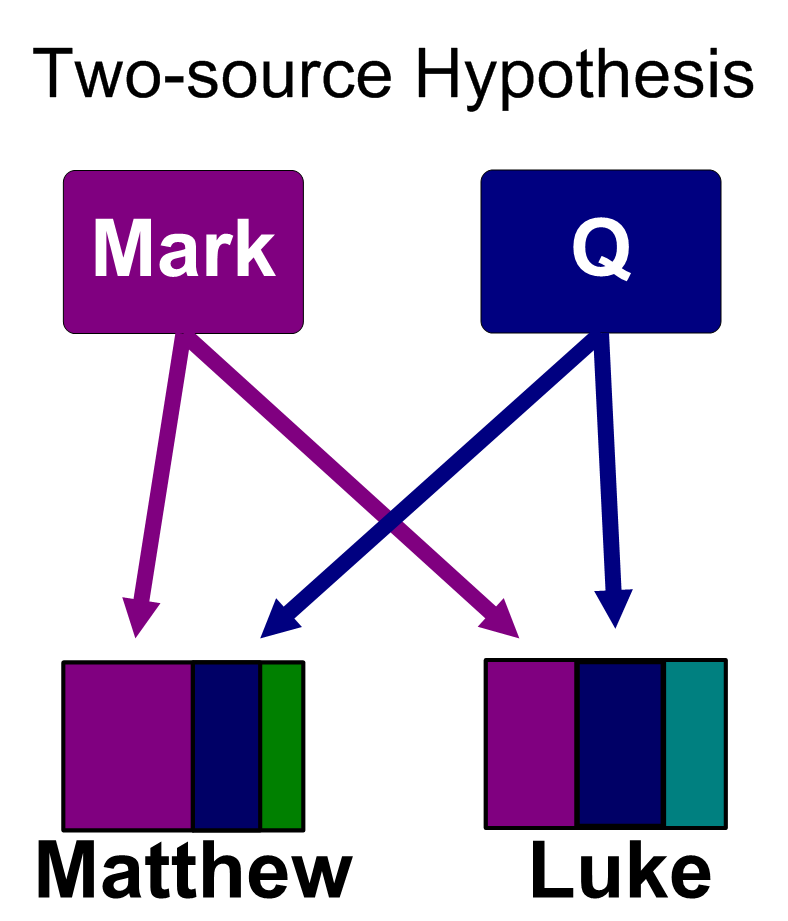
One attempt by these theoreticians was to try to say all the witnesses collaborated after a few decades by establishing a short, common written source. There were no miracles so this core was Christ's teachings. It was known as Q, for Quelle, source in German. Q was used to distinguish those passages in Matthew, Mark and Luke that look similar, one way or another. It is like saying: "I found a jigsaw piece that has the same shape as the gap to be filled -- more or less."
In the two source or multiple source theory, Q was added to the shortest gospel, Mark -- which they say was the early source --to edit and make versions called Matthew and Luke which are longer.

Q is a vapor!
Using Q as a basic story they supposedly invented other parts of the gospel narratives much later. Trouble is: no one has actually found this writing among the many thousands of manuscripts that have been preserved! We have more manuscripts of the New Testament than any other contemporaneous books in Greek or Latin -- thousands. Yet not one of Q!
 We have many early translations into Syriac, Coptic Greek, Gothic, Latin etc. Not one of Q!
Heretics made up lots of faked gospels. They survive in their hundreds. There is no manuscript of Q among them. Nor do the heretics use anything like Q! They all look like sectarian fakes!
Conclusion number one: Q did not exist.

Vapor dispersion
That does not stop Q theory being highly popular in seminaries today.
Most churches teach it. Why? 
While any sensible person would examine whether this idea is sound before teaching it, modern professors with no scientific training in logic don't. It has the superficiality of truth. It is a veneer only. Certain forms look alike. The problem is they don't make any sense.
Superficial form made it popular enough to be taken on board uncritically by church "teachers" who like to shock unprepared students. They in turn, when they become teachers, pass it on. Most church seminaries teach this false theory about the origin of the first three Gospels of the New Testament as fact. But the Q Theory or Q hypothesis is a falsifiable, as all theories and hypotheses are.

Delusion reigns.
This theory, created in 19th century Germany by skeptics and atheists wanting to destroy the primacy of the Bible, is now accepted widely by academics and theologians. By having a 'school' they can all write learned articles about the inconsequential details of a word, while ignoring the falsity of the whole.
It has become more and more popular as the level of general education has fallen. It can be refuted by a better understanding of first century history and a better application of logic.
Flawed logic of the Q theory should make it a target for debunking. But professors teach it rather than debunk it! Students seem unwilling to call out the errant professors. Theory masquerades as fact. Its basic prejudice should also preclude it from claiming impartial truth. Ignoring the historical context of the building of the canon should give Q a failing "D" grade.

When  were the Gospels written?
During the lifetime of Jesus. For example his royal and priestly birth was verified and logged in the official family records at both Bethlehem and Nazareth/Sepphoris and the Temple genealogies as well. (Josephus and others describe how comprehensively and minutely these were kept.) Jews and Nazarenes were the most meticulous pedigree keepers, far exceeding any Gentiles.
For kings, tribal leaders and priests and all who wished to enter the Temple, these official records were extensive. They had to show that a child had at least a ten-generation pedigree, each legitimately born of married parents. The marriages (betrothals) and weddings (home-coming) and births had to be witnessed by multiple, proven honest witnesses, all recorded. Matt 1 and Luke 3 show the royal and priestly lineages respectively, (Jesus, James, Joseph and the past and future Temple, chapter 10).  
Luke was written soon after 37 CE when the "Most Excellent Theophilus" was in office as Luke 1:1 records. He says also that many had already written histories and biographies of Christ. Luke's gospel (without this dedication) was probably in circulation before late 37 CE, when Theophilus son of Annas became high priest.
What we have is the official or Temple version of Christ's life and work. Matthew was originally written in Hebrew. As such it was also deposited in the Temple archives. So it was written immediately, targeted at a readership of Christ's spectators and followers. It was well known among Jews in Jerusalem and also Hebrew-speakers in the Diaspora, such as Parthia and Babylon. (See the chronology of Temple high priests in chapter 14 on and the high priest list pp239ff in Jesus, James, Joseph and the past and future Temple.) 

Pseudo-scientific methodology
Poor logic and distorting facts should make Q theory unacceptable to Biblical students. A valid theory must stand on proven premises. False premises should rule it out before primary consideration. Students need adequate knowledge of the history of Christianity to define the premises. Sadly they do not have this background before they are bamboozled by power-posing professors.
Yet because it requires no historical, logical or scientific knowledge, the superficiality of saying three or four coherent gospel accounts must indicate an original written Q source, has made it popular among some academics.That assumes the disciples weren't capable of recording their own observations separately.
The rationalist /skeptical school is based on two false ideas: the resurrection did not take place and all the prophecies were written after the destruction of the Temple because no one could make such prophecies. Hence the dating of the gospels is all mixed up. The gospels are dated to the 80s, 90s and into the second century!

History confirms the Resurrections.
Hypothesis and conclusion: If the Resurrection is true, then historians would expect a major crisis in the Roman Empire. This would occur in the 30s and 40s when the astounding news was spread around.
It did!
Remember, there were many resurrections among the Jewish Nazarenes and others. Jesus appeared as a transformed being before the Jerusalem city officials and the legions in Jerusalem.. But a number of other dead individuals were raised to physical life again. These resurrected people included Lazarus, the widow of Nain's son but also many, many others. The gospels speak of other resurrections without naming names. They included the saints that were resurrected from their graves at the same time as Jesus, Matt 27:52. Even Josephus speaks of the great miracles of Jesus. Independent accounts of these exist, plus imperial, legal confirmation. Some are republished in Jesus, James, Joseph and the past and future Temple, chapter 32.
Josephus also speaks of the virulent anti-Semitism that took place before these events. The man who was officially responsible was not so much emperor Tiberius but his deputy, Sejanus. He was power-hungry and plotted to usurp Tiberius. When Tiberius found out about it, he carefully dismantled the plot and had Sejanus executed. He then looked at the evidence of the Resurrection, including reports from Pilate, and agreed it had taken place. He proclaimed Jesus a god! And he forbade Romans to persecute any of his followers on pain of death.

History proves armchair atheists wrong!
This shows that, contrary to armchair atheists, the proofs of the Resurrections were in full circulation, right after the events of 30 CE. There is no need to hypothesize that Christianity was some sort of minor movement of his dispirited followers who spread rumors of his teachings which somehow spread over the course of a century or two.
What happened after Tiberius died in 37 CE adds more proof that the gospels were all well-known among imperial circles. They were not only well-known but feared. The Resurrection of a Jewish King was distasteful to imperial Romans, because they despised the Jews. Worse. The Jews did not believe in the Roman Pantheon of Jupiter, Minerva and Mars etc. This Jewish God was better than all of them because contemporary Romans and others knew that the Roman Governor Pilate and the legions had all witnessed the resurrection of Jesus. They had probably interrogated the others who had been resurrected from their graves. The documents we have of later Caesars all seem to agree with that.
What of Tiberius's successor, Gaius Caligula? He was faced with the crux of the crisis. Either he accepted Tiberius's position and inevitable decline of the Roman gods and the Roman Empire or he had to give some proof of his own power above that of the Jews.

Caligula tries to be Christ.
In effect Caligula mobilized the whole Roman Empire against the Christians in a show of force and imperial power. Christ said he would come again to the Temple and an Abomination would also try to seize power. Caligula 37- 41 CE said he was god of the world, Jupiter himself. In his mind Jupiter was the king of the gods. 

The records of Philo, Josephus and Roman historians show that Caligula wanted as Jupiter to set up his capital and military HQ  in God's Temple in Jerusalem.
He would first defile it with a huge golden idol of Jupiter in the Holy of Holies. That would not only cause a Jewish insurrection against him. It would risk war with Jews and Israelites around the entirety of the Empire.
Caligula told his supreme military commander in the East, Petronius in Syria, to be ready for war on two fronts, inside and outside the Empire. He would massacre all disobedient Jews in Israel and elsewhere. Even worse this act would set ablaze a world war with the mighty Parthian Empire to the East. Many were Israelite exiles who had paid for the Temple reconstruction. Petronius set half his legionary forces against possible Parthian attack.
Did Caligula take Parthia too lightly because of their restraint during a half-century of peace? Or did he feel the war with Rome's greatest super-power foe plus eradication of all Jews and Nazarenes was necessary to resolve his Christ problem, that would inevitably entail Rome's pagan demise? 
Philo describes this in detail. Parthia had already defeated Roman legions under Rome's greatest generals multiple times (chart summary in Jesus, James, Joseph, p372). It was only when Tiberius agreed to peace with Parthia that the Temple had been rebuilt in 20 BCE.  This had brought a great and prosperous peace to Rome. Among other benefits was that the Silk Road to China was open to trade.

Roman gods die! So does Caligula!
Caligula wanted to risk all this in order to sit in the Temple of God. This was not madness, but power politics and egomania. Caligula risked the entire Empire on the idea that the Resurrection was false and his legions mightier than God. He did so because the gospels and many other proofs were circulating in Rome in 37-41 CE. Unless he defiled the Temple, the "Jewish God" would triumph over Roman gods and its emperor.
Caligula was well informed about the logical outcome of the Resurrection and the dangers for the Empire. So was the Senate. It refused to acknowledge the death of the Roman gods. The Resurrection showed they were all false gods. The Senate said they were in control of naming the gods. The Resurrection showed they were not. The world had thousands of expert witnesses saying the Resurrection was a real event.
Caligula tried to stop the inevitable rot and decay of the pantheon.
He declared he was the almighty Jupiter. He would kill any who refused to worship him. He would sit in God's Temple in Jerusalem as the immortal, supreme god himself! But he was attacked by his own guards! He died as he was about to set off for the East.

"To change God into a man is more easily done, than to change a man into God!" wrote Philo. (Jesus, James, Joseph, p 673).


The whole Roman pantheon that had existed for a thousand years collapsed in the first and second centuries. The world rejected Jupiter/ Zeus, Mars, Diana etc as false and fraudulent. They then turned their worship to new gods including the Sun. That deistic decimation wasn't done by Christians whispering to each other and passing on anonymous screeds. The gospels were written, not in a professorial study, but amid the most dramatic events of Roman history.

Those who support the Q theory willingly ignore the facts of history. The Q methodology assumes the gospel writers were like 19th century atheist German novelists cutting and pasting documents among friends for their amusement.

Circular arguments
Proponents of Q theory are in danger of falling into the vortex of a circular argument.
The theoretician Kloppenborg came up with the Q3 theory with three levels of Q documents in the gospels. He  defined Q1 as the earliest with only the Sayings of Jesus. He excluded by his definition anything other than these contextless words. Hence it would not have any reference to the aspects that are missing. Kloppenborg and friends did not like these other bits for his Q1. The second layer that later, so-called editors added was the prophecies. He called the prophecies Q2. Then the historical facts and geography were added. He called this supposedly later-written context, Q3. This mythical third layer of editing arose much later as the framework we see in the last redaction of MSS. Who wrote it? Unknown editors added this in a mysterious, still hypothetical document, that no one has ever seen.

If you believe this, consider my equally fictitious claim that I really wrote Q3 of Shakespeare and I claim all copyright on his plays! Or maybe Moby-Dick.

Q theory of Moby-Dick
I could do the same for a theory of the Q source in Moby-Dick by saying Herman Melville originally had two sources, Q1 without whales and Q2 about whales. Then I could say: "I'm glad Herman did not originally believe in killing whales! Q1 proves it." People could have great fun separating out the jigsaw pieces of which belong to Q1 and Q2.
The Q theory assumes that the earliest NT written source dates from the 50s. Not true. The Jews and the Romans had stenographers that recorded important speeches, especially those leading to trials or theological discussions in the Temple and elsewhere. The historical data and context of the gospels (including attempted ethnocide of Christians/ Nazarenes and Jews by Caligula, Nero and Flavians) are ignored in Q theory. 

Naming the Gospels
The complementary idea is that none of the gospels was written by people called Matthew, Mark, Luke and John. They were all anonymous at first for a century or so. Unfortunately for these novelist-theorists facts of history make nonsense of their armchair imaginations. There are no anonymous manuscripts. If there had been anonymous MSS circulating for decades, we would expect see scores of invented attributed authors (provided Christians were dishonest enough to invent authors for anonymous MSS). Prof Brant Pitre gives an intelligent and logical Roman Catholic rebuttal of modern skepticism in the theology he was taught and originally accepted at his universities at https://www.youtube.com/watch?v=NzQqYtJciOE Good to see a Roman Catholic academic going back to the Jewish roots of Christianity. Worth watching!

Monday, April 17, 2017

Review of PBS film: 'Last Days of Jesus"

The academics should be commended in trying to bring some contemporary Roman background into the gospel history. The PBS film on the "Last days of Jesus" can be found on You Tube at https://www.youtube.com/watch?v=gLStDEBPCfo&t=3848s They did not however begin to address the major problem of Jerusalem politics: the Temple. This had been rebuilt with the aid of Parthia, the Israelite-run Super-State rival of Rome -- with whom Tiberius had tried to make and keep peace.  Vast populations of the Diaspora in Europe had also contributed in anticipation of the coming Messiah.

1. Sejanus was a key figure, a fervent anti-Semite. He like other Romans hated the fact that the Jews and the Temple were not subsumed in the Roman central control of the pantheon and the College of Pontiffs. Historical facts of the gospels in a Hebrew context make perfect sense. The scholars have, however, indirectly pointed to problems arising from the "Easter" week tradition of 4th century Constantine's imperial church. That tradition arose once he had eliminated all Jewish Christians. (The latter knew about the Passover dates, Davidic kingship and true high priesthood.) It is not honest scholarship if "scholars" re-write the gospels at their whim because of these conflicts or ignorance of first century Judaism. If the gospels are read as Jewish-Christian or Nazarene documents, many of the supposed "difficulties"disappear. See nazareneproject.com articles or  https://www.academia.edu/43233588/ Jesus_James_Joseph_and_the_past_and_future_Temple 
2. However, the program's theory of stretching a day to six months (including a half-year stay of Jesus in prison) does not hold water. The chronology is forced out of shape. The Crucifixion/ Resurrection occurred in 30 CE (verifiable by the Hebrew calendar). Sejanus was at his peak of power. Major facts left out: Christ cleansed the Temple at least two times. He cleansed it at the start of his mission. What is remarkable is that he had no resistance from the armed Temple guard, nor did the Roman legions intervene. What did he cleanse? The area was the periphery of the square Temple complex which was a furlong in length. The merchants' area may well have covered half a mile. Furthermore Mark 11 says he let no one carry vessels through the Temple. Alone? The gospels say the Temple guards ('the boys') cried Hosanna! He was in charge of the Temple guard! He had authority as an Aaronic priest because his mother was a daughter of Aaron, a direct descendant. So was John the Baptist via Elizabeth (Elisheva). John is called a high priest in the Hebrew Josephus. The next morning the high priests like Caiaphas, Annas came peaceably like kittens to converse with Jesus. Their question was about authority. Jesus had this. They didn't.
3. What is the picture with the correct chronology of 30 CE? Tertullian and others confirm that Pilate wrote dispatches to emperor Tiberius that the Resurrection actually happened and was eye-witnessed by the masses. It was undeniable. hence Tiberius acclaimed Jesus as god. The Senate (which was then led along by Sejanus) objected. They dug out an old law saying the Senate had to approve in the naming of gods! Tertullian mocks them, saying the poor gods, they would have to pray to the Senators that they should be recognized! Tiberius replied that anyone who attacked the Jews would be killed. It was at this stage that the plot of Sejanus fell apart. Sejanus was exposed and executed in autumn 31 CE. Later secular writings to the emperors indicate that Christ's divinity -- via the Resurrection -- was not challenged. The proof was irrefutable. Jesus was not a Protestant-style "preacher". He was a Teacher, a Temple Teacher. He taught in the Temple -- which is why the Davidic and Aaronic genealogies are in the gospels. They provide the proof of his authority. (It was forbidden to enter the Temple with long hair! ) The high priests call Pilate "Lord" as representative of Rome. But Jesus didn't. Why wasn't this a crime? He outranked Pilate. Pilate calls him King of the Jews and says he is innocent of any crime. Why? Because the Temple was considered a separate City-State with its own rules and armed priests. This was recognized in the treaty Julius Caesar made with the Maccabees.
If the academics would have stuck to the facts and proper dates, and avoided pet theories, they would have had a clearer explanation of many if not all of the problems they were seeking to elucidate. They would have also found that for the Romans, for Tiberius and for Pilate and Sejanus, 30 CE and 31 CE were not the 'Last Days of Jesus'!

Sunday, April 9, 2017

Pilate, Sejanus and the Resurrection of Christ

1. Jesus Christ (=the anointed king) was crucified on a tree in 30 CE.
It was not his 'last days' as he was resurrected to the general knowledge of all at Jerusalem. Forty days later he ascended in full public view from the Mount of Olives -- this would have included all the priests and people in the Temple and all the soldiers in the Roman Fort, the Praesidium (up to 10,000 legionnaires and ancilliaries) plus all the pilgrim crowds.
The second-century Christian lawyer,Tertullian, recorded that Pilate wrote dispatches to the emperor Tiberius about this to give the official version as everyone around the empire already knew about it.
Pilate was extremely anti-Semitic and had probably been placed there by the violently anti-Semitic Sejanus to stir up trouble. Yet he affirmed the eye witness accounts.
Sejanus had been plotting for years to overthrow Tiberius who had retired from official duties for sex games in Capri.Sejanus, his Praetrorian Guard chief, was de facto emperor. He became so powerful and manipulative that many Romans worshipped in a cult. He was a smooth operator with the Senators who were vital should he succeed in his plan.No one could put their name forward as a Consul without his favour. Sejanus became a Consul with Tiberius -even though he was not ranked as a Senator. With this Sejanus hoped that he would just eliminate Tiberius and everyone would presume he should be emperor although he was not of any imperial family. He was overcome with egotism -- and hate of Jews.
Sejanus, possible statue
2. The Resurrection threw this long-gestating plan into a spin. Tiberius, say Tertullian and other early writers, acknowledged that Jesus Christ was god. Sejanus and the Senate tried to stop this as it would mean ruin for their centralized control after a coup d'État.
The Senate pulled out an old law that said that only the gods approved of by the Senate were gods! This was clearly nonsense as a royal and priestly Jew had been resurrected to everyone's knowledge.
Tertullian mocks this pagan foolishness, saying the poor gods would have to pray to the Senators so they could be recongized as gods!! Furthermore many saints as Matthew says rose from their graves at this time. The archaeological and written proof of this are in the book.
3. Sejanus's reaction later in 30 CE and early 31 was to try to exterminate all Jews. That's what Philo and others say. Exterminating all believers would mean that Rome could turn back to ribald, old-time paganism. Instead his treasonous plot was revealed to Tiberius (who was not so anti-Semitic and more interested in maintaing imperial peace with Parthia). The old emperor did some some careful investigation and deft political footwork. Sejanus was "dethroned" and skewered.
Tiberius then proclaimed that anyone persecuting Christians (or Nazarenes as they were then called) would be killed. The ekklesia had seven years of peace.
4. Sejanus, who had been head of the Pretorian guard, was replaced by Macro. Gaius Caligula colluded with Macro and killed Tiberius. Caligula's way of dealing with the Nazarenes and the Jews/ Israelites/ Parthians/ Kelts was to provoke the Jews into a war of extermination, while trying to hold off the Parthian Super-Power enemy so they would not come to defend Jerusalem and the Jews.
Caligula already had his statue set up in all synagogues around the Empire. Jews suffered at this idolatry. Caligula wanted to go to Egypt where he would be made a god, 'as Egyptians knew better than Romans how to make a man divine'.
Philo Judaeus of Alexandria in Egypt made the cutting but careful remark: "to change God into a man is more easily done than to change a man into God.'
The Roman Supreme Commander in the East stationed in Syria, Petronius, prepared for war with Parthia. It seemed inevitable. Why? Caligula had ordered him first to set up a giant gold statue of Caligula as Jupiter and place it in the Jerusalem Temple. After that Caligula said he would come and set up his imperial Roman headquarters in the Temple.
We can easily guess why. Because Christ had said that 'an abomination of desolation' would sit and rule in the Temple as God. Caligula wanted to prove Christ wrong.
This act would have meant World War as Jews and Parthians and the Israelite Diaspora would attack and defend their most beautiful and precious City and the holy Temple to which they had all contributed in rebuilding for half a century since the time of the Parthian peace treaty.
Both Philo and Josephus say that the Israelite Diaspora were in number the greatest people on earth, though scattered in several countries and islands.
5. World War did not come. Caligula failed to conquer Britain, where Christianity took hold and was evangelizing the Continent. The "Triad of Lazarus" showed how false his divinity claim was. Caligula was assassinated in a back alley in Rome as he prepared to leave for Egypt. Dogs drank his blood. These dramatic events only added to the number of believers around the world.

Monday, March 20, 2017

Was there a "lost century" of Christian history after 70 CE?

Does the "Lost Century" of Church history exist?
NO
This so-called missing century goes from just before the destruction of the Temple in 70 to 150 or 170 CE. What happened to the Church?
1. The first mistake is to use the term 'church' . It is not in the Bible! Early believers were called an ekklesia. As a Greek term, it means congregation, an official assembly. The later "Church" is a pagan term, reflecting pagan organization and pagan structure. The ekklesia translates the Hebrew qahal or tribal or national Congregation or assembly. It is a very specific term. The qahal were Israelites and composed the Congregation of Israel that met in the Temple for specific rituals.
Ever wonder why the book of Acts speaks of 120 'names' witnessing the Ascension of Christ? Names means that they were nominated. They were ambassadors from the twelve scattered tribes of Israel. Jesus visited all the tribal capital cities -- as is clear from the NT. Shechem was Joseph and other patriarchs were and are buried. 120 = 12 x 10. They came from Parthia -- Rome's superpower rival to the East -- and from wherever the Israelites were scattered.
2. Part of the confusion about the early ekklesia in the period 50 to 150 is due to the popular history sources people use. Many books quote Gibbon who was a skeptic. He discounts the Resurrection as a real event, ignores important witnesses, and downplays Philo and Josephus. They record that Sejanus, who had practically the power of emperor while Tiberius was semi-retired in Capri, acted much like Hitler or Islamic State against the Jews. He led many of the senate who wanted to exterminate all the Jews. Why? This was in the early 30s, even before Caligula took power. Sejanus had Tiberius's son Drusus poisoned and wanted to take over the Empire. Tiberius was alerted and had him removed and executed. Gibbon omits these major events of the first century and then talks about a 'thick mist'! That's hardly surprising: remove some facts and claim a mystery.


What was going on? The Resurrection threatened Rome. In his chapter 15 he hardly deals with Caligula -- except calling him mad. It is hardly a coincidence that Gaius Caligula emperor 37 to 41 CE decided to call himself 'God' and Jupiter. Rome balked at this, so Caligula said he would go to Egypt who were experts in making emperors gods. 
Then he said he would set up his headquarters in the Temple in Jerusalem. Why the Temple? He would challenged Almighty God and all the prophecies of Christ about the Abomination of Desolation! 
Read Tertullian and it is easy to understand. He lived in a time a century later when he was freer to tell the story without being attacked.
He said that in 30 CE the emperor Tiberius agreed to call Jesus 'God' because he was convinced by the reports from Pilate about the Resurrection. Why did not the whole Empire proclaim the resurrected Jesus as God? Tertullian says that the Senate refused. Why? Because they knew a resurrected Christ, officially recognized by the State, would undermine the whole pantheon of Rome -- Jupiter, Venus, Mars, Minerva etc. They said the Senate (at odds with Tiberius) had powers to define who was a god. 
Jesus proved this was crazy! It was a nonsense because everyone knew Christ was God. He had multiple witnesses.  High priests and worshipers, Pilate, the legions and the whole of the population of Jerusalem had seen him rise from the dead and ascend to heaven. This knowledge is confirmed in many early writings of the centuries.
3. The Temple was the center of Christian worship. The ekklesia met in the Temple. The ekklesia also met in areas outside the Roman Empire, where the number of representatives was always a multiple of 12. The early writings tell how the apostles visited some of these Israelite areas.
In the Empire Christians giving public speeches about the resurrection of Jewish Christ and his coming again to the Temple to judge them would be worse than doing the same thing in the Soviet Union or Nazi Germany! The Roman Empire was a military dictatorship. It then destroyed the Temple! That did not change the resurrection as a fact! But it's when the extirpation of Jews and Christians began. They were made slaves, thrown underground to work in the mines, never to see sunlight again.
4. What the historians do not deal with -- the immediate destruction of much paganism because of the Resurrection. It showed paganism was false. The result of destroying the Temple? Not what the Romans expected. The Roman pantheon was DESTROYED. No one spoke much of Mars and Jupiter, Venus again. Nor do they have worshipers today! In the second century even the emperors recognized that Jesus was God! See Justin Martyr. The pagan priests (pontiffs) turned the people to sun worship and then to Mithraism.
You will find all the details in the book : Jesus, James, Joseph and the past and future Temple. It is available as a free electronic version on academia.edu at
http://www.academia.edu/…/Jesus_James_Joseph_and_the_past_a…
The mists and mystery of a 'lost century' only exist for those who do not believe in the Resurrection!